
The Book and Its Provenance
Every rare book has two histories: the printed work and the surviving copy. This copy of Nouvelle Anthologie Françoise (Paris, Delalain, 1769) preserves both.
The flyleaf bears an oval “Ex Libris de Cayrol” stamp, the autograph “De Cayrol,” and a bibliographical annotation written in the same hand and ink. The owner can be identified as Louis Nicolas Jean Joachim de Cayrol (1775–1859), a French military administrator, historian, deputy, and bibliophile.
The first line of the annotation can be read with high confidence as referring to Claude-Sixte Sautreau de Marsy (1740–1815), compiler and editor of Nouvelle Anthologie Françoise. This identification resolves earlier uncertainty over the surname.
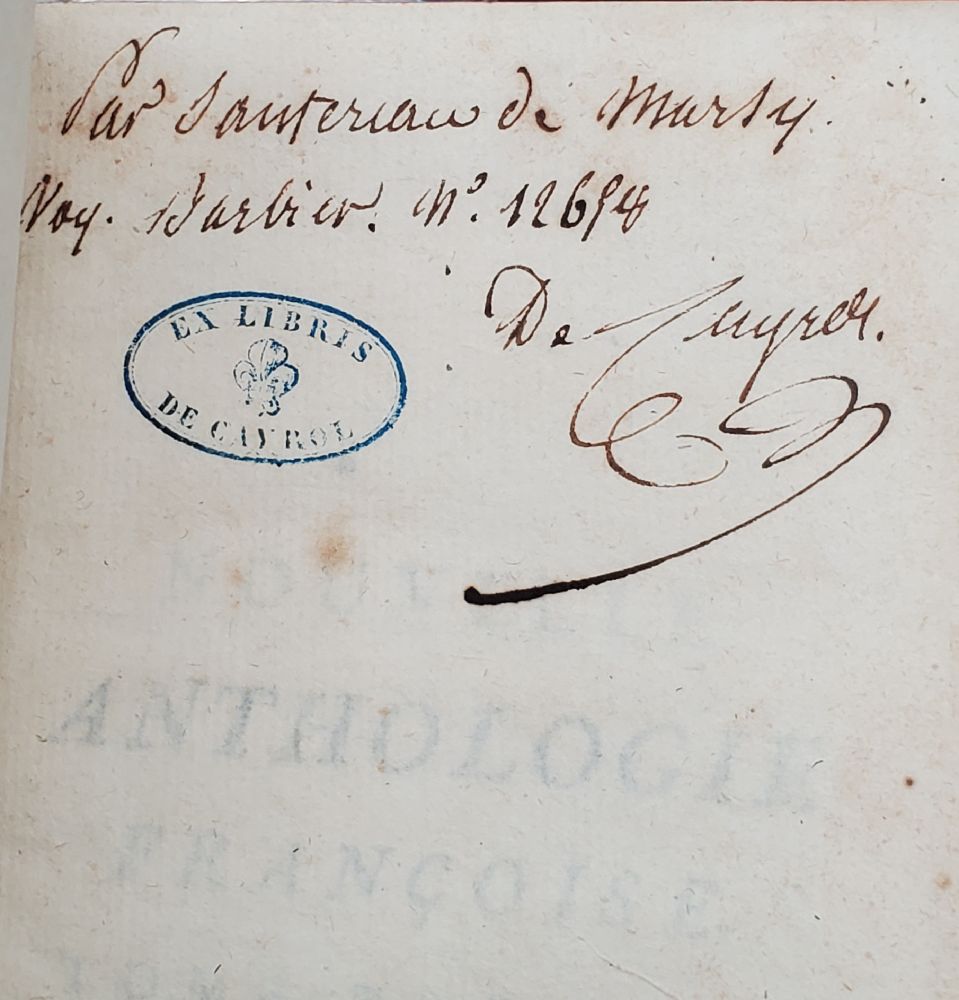
The second line remains only partially deciphered but appears to read in substance, “Voy. Barbier No …” The abbreviation “Voy.”, for voyez or “see,” together with the surname Barbier, strongly suggests that Cayrol was directing the reader to a bibliographical authority rather than merely recording ownership. The remaining number is still uncertain.
The most likely Barbier is Antoine-Alexandre Barbier (1765–1825), the celebrated French librarian and bibliographer whose works became standard references during the early nineteenth century. Modern catalogues continue to cite Barbier when describing this anthology.
Accordingly, the inscription is best understood as a scholarly bibliographical annotation made by Cayrol during the early nineteenth century. Although the final catalogue reference remains unresolved, the annotation clearly identifies the editor of the anthology and points the reader toward a standard bibliographical source.
Dating the Manuscript Annotation
Although the flyleaf annotation is undated, its approximate age can be inferred with reasonable confidence. The note appears to have been written by Louis Nicolas Jean Joachim de Cayrol, whose autograph and Ex Libris stamp accompany it in the same hand and ink. More significantly, it appears to refer to Antoine-Alexandre Barbier’s Dictionnaire des ouvrages anonymes et pseudonymes composés, traduits ou publiés en français. The first edition was issued between 1806 and 1809, providing a terminus post quem for the inscription. Since Cayrol died in 1859, the note must date from the first half of the nineteenth century. A date of circa 1810–1825 is a reasonable inference, although the exact year cannot be established.
Institutional Holdings
Nouvelle Anthologie Françoise survives in the collections of major European research libraries, including the Royal Library of Belgium (KBR) and Trinity College Dublin. The KBR catalogue cites Barbier, III, 542, as the standard bibliographical reference for the work. That independent catalogue entry supports the interpretation of Cayrol’s “Voy. Barbier …” note as a scholarly cross-reference rather than an ownership inscription.
This volume therefore preserves an unusual provenance chain: publication in 1769, later ownership by Louis Nicolas Jean Joachim de Cayrol, and a scholarly annotation linking the work to Sautreau de Marsy and Barbier.
Biographies
Claude-Sixte Sautreau de Marsy (1740–1815)
Sautreau de Marsy was far more than the compiler of a single anthology. He was one of the more active literary editors of late eighteenth-century France and spent much of his career preserving, organizing, and disseminating French literature rather than creating original works. His most enduring achievement was the founding of the Almanach des Muses in 1765, an annual literary anthology that became one of the principal vehicles for contemporary French poetry and continued publication long after he relinquished editorial control.
Working as a journalist, editor, and man of letters, Sautreau de Marsy contributed to several literary periodicals, including the Journal des Dames and L’Année littéraire. His career reflects the literary culture of the Enlightenment, when editors increasingly acted as curators of French letters. Rather than producing a large body of original work, he compiled, edited, and annotated texts that preserved the literary heritage of earlier centuries while introducing contemporary readers to new poetry and prose.
Among his principal publications are Nouvelle Anthologie Françoise (1769), Recueil des meilleurs contes en vers, Le Petit Chansonnier François, Annales poétiques, and numerous historical and literary compilations. He also edited works by Dorat and Duclos and collections of the letters of Madame de Maintenon, demonstrating his reputation as a trusted literary editor.
The identification of Sautreau de Marsy in Cayrol’s annotation is therefore significant. Cayrol was not merely asserting ownership; he was identifying the compiler of the anthology and documenting the volume’s bibliographical identity.
Louis Nicolas Jean Joachim de Cayrol (1775–1859)
The owner of this volume, Louis Nicolas Jean Joachim de Cayrol, was a French military administrator, historian, public official, and bibliophile whose career spanned the Revolutionary era, the Napoleonic Empire, and the Bourbon Restoration. Born in Paris on 25 June 1775, he entered public service at a young age and held a succession of military and administrative posts. His surviving writings reveal a man equally interested in government, historical scholarship, and the documentary record of France.
Cayrol served in military administration and later became attached to the Ministry of War, where he rose through increasingly responsible appointments. Following Napoleon’s fall, he continued in public service under the restored monarchy. His career eventually extended into elective politics, and he served as a deputy while maintaining active interests in historical and literary research.
Beyond public service, Cayrol established a reputation as a historian and antiquarian author. His publications concentrated on French military and administrative history, reflecting both his professional experience and his interest in archival research. Like many nineteenth-century scholars, he relied upon libraries, primary documents, and printed bibliographies, recording references and authorities as part of his working method.
The present volume offers a revealing glimpse of those habits. It bears both an oval “Ex Libris de Cayrol” stamp and the autograph “De Cayrol.” The flyleaf annotation appears to be written in the same hand and ink as the signature. It identifies Claude-Sixte Sautreau de Marsy as the compiler of the anthology and appears to direct the reader to Barbier.
This evidence substantially enhances the historical interest of the volume. Without Cayrol’s annotation, the book would remain a desirable eighteenth-century literary anthology. With it, the copy becomes evidence of nineteenth-century scholarly practice and preserves the working note of a historian who treated his personal library as an active research collection.
Although the final portion of the annotation remains undeciphered, its purpose is reasonably clear. Cayrol was documenting the book’s bibliographical identity and connecting it with the wider literature that described it.
Antoine-Alexandre Barbier (1765–1825)
Few bibliographers have exercised as lasting an influence on the study of French books as Antoine-Alexandre Barbier. A librarian, bibliographer, and scholar, Barbier devoted his career to identifying, cataloguing, and preserving France’s literary heritage during the upheavals of the French Revolution, the Napoleonic Empire, and the Bourbon Restoration. His name remains inseparably associated with the monumental Dictionnaire des ouvrages anonymes et pseudonymes, a reference work still cited by librarians, antiquarian booksellers, and scholars.
Born at Coulommiers on 11 January 1765, Barbier was educated for the priesthood and ordained in 1789. The French Revolution redirected his career. After accepting the Civil Constitution of the Clergy, he eventually left the priesthood and entered public service. In 1794 he joined the Commission temporaire des Arts, which was charged with recovering, preserving, and distributing books confiscated from churches, monasteries, and émigré libraries.
Barbier’s expertise led to a succession of prestigious appointments. He served as librarian to the Directory and as conservator of the library of the Conseil d’État before being appointed Napoleon’s personal librarian in 1807. In that capacity he advised the emperor on newly published works, assembled imperial libraries, and assisted with the libraries of the Louvre, Fontainebleau, Compiègne, and Saint-Cloud. After the Bourbon Restoration, he became administrator of the private libraries of Louis XVIII and remained one of France’s leading bibliographical authorities until his dismissal from royal service in 1822.
His enduring legacy rests upon the Dictionnaire des ouvrages anonymes et pseudonymes composés, traduits ou publiés en français. First published between 1806 and 1809 and enlarged in later editions, it systematically identified the authors of anonymous and pseudonymous French publications. The work transformed bibliographical scholarship by bringing dispersed information together into a single organized reference and established a standard that later bibliographers continued to refine.
Barbier’s importance to the present volume is direct. The flyleaf note appears to read in substance, “Voy. Barbier …”, indicating that Cayrol was pointing readers to Barbier’s bibliographical authority. The KBR catalogue’s independent citation of Barbier, III, 542 for Nouvelle Anthologie Françoise reinforces that interpretation.
References
- Nouvelle Anthologie Françoise. Paris: Delalain, 1769.
- Royal Library of Belgium (KBR). Catalogue record for Nouvelle Anthologie Françoise, citing Barbier, III, 542.
- Wikipedia contributors. “Claude-Sixte Sautreau de Marsy.” Wikipedia. https://en.wikipedia.org/wiki/Claude-Sixte_Sautreau_de_Marsy.
- Bibliothèque nationale de France. “Claude-Sixte Sautreau de Marsy.” BnF authority record.
- Vapereau, Gustave. Dictionnaire universel des littératures. Paris: Hachette, 1876.
- Wikipedia contributors. “Louis Nicolas Jean Joachim de Cayrol.” Wikipedia. https://fr.wikipedia.org/wiki/Louis_Nicolas_Jean_Joachim_de_Cayrol.
- Bibliothèque nationale de France. “Louis Nicolas Jean Joachim de Cayrol.” BnF authority record.
- Wikipedia contributors. “Antoine Alexandre Barbier.” Wikipedia. https://en.wikipedia.org/wiki/Antoine_Alexandre_Barbier.
- Bibliothèque nationale de France. “Barbier, Antoine-Alexandre (1765–1825).” https://catalogue.bnf.fr/ark:/12148/cb11890148t.
- Fondation Napoléon. “Barbier, Antoine-Alexandre.” https://www.napoleon.org/en/history-of-the-two-empires/biographies/barbier-antoine-alexandre/.
- Barbier, Antoine-Alexandre. Dictionnaire des ouvrages anonymes et pseudonymes composés, traduits ou publiés en français. Paris, 1806–1809; expanded second edition, 1822–1827.