
From Ohio Foundry to American Toymaker
Among collectors of American cast-iron toys, the names Hubley, Arcade, Kenton, and A. C. Williams occupy a special place. Their miniature automobiles, trucks, farm equipment, airplanes, banks, and horse-drawn vehicles capture an era when children's toys were manufactured with much the same materials and industrial methods used to make full-size machinery.
A. C. Williams is particularly interesting because it did not begin as a toy company at all.
Its history reaches back to 1844, when John Wesley Williams acquired an existing foundry operation in Chagrin Falls, Ohio. The early business manufactured practical iron products rather than playthings, including pump hardware, plow components, wagon hardware, stoves, and other castings.
A history preserved by the Chagrin Falls Historical Society describes a business deeply rooted in nineteenth-century American iron manufacturing. The foundry produced an expanding variety of goods as transportation, agriculture, household technology, and industry developed around it.
Adam Clark Williams, John Wesley Williams's son, would ultimately transform the family enterprise.
 According to the historical account, Adam entered the foundry full-time in 1865. By 1872, he had become a partner and the business was operating as J. W. Williams & Son.
When John Wesley Williams died in 1886, Adam assumed control.
At that stage, the company remained primarily an iron foundry producing practical goods. Among the most important were cast-iron sad irons and related household products.
Those heavy household objects would eventually provide both manufacturing experience and perhaps inspiration for the smaller castings that made the company famous among toy collectors.
Fire, Rebuilding, and the Move to Ravenna
The history of A. C. Williams might have ended before its great toy-making period began.
In 1889, the Chagrin Falls factory was destroyed by fire.
The account preserved by the Chagrin Falls Historical Society offers an unusually vivid picture of the disaster. Adam Williams was returning from a business trip when he learned that his factory was burning. Local workers and townspeople rallied around the company, offering labor, transportation, and assistance with reconstruction.
The factory was rebuilt.
Then disaster struck again.
On Thanksgiving night in 1892, another fire destroyed the works.
The repeated losses exposed the limitations of the Chagrin Falls location, particularly its transportation and fire-protection infrastructure. Williams decided to relocate.
In 1893, the business moved to Ravenna, Ohio.
The move proved pivotal.
Ravenna provided better transportation connections and offered a more favorable setting for industrial expansion. The company gradually developed into a substantial producer of hardware, household specialties, and toys.
A contemporary biographical history published in 1910, the History of the Western Reserve, confirms the two fires, the relocation, and the growing range of goods produced by the company.
By that time, A. C. Williams products were being distributed far beyond Ohio.
A Family-Owned Industrial Company
In 1905, the enterprise was reorganized as a stock corporation with capitalization reported at $200,000.
Adam Clark Williams served as president and general manager.
His son John W. Williams became vice-president and secretary, while son-in-law James H. Bigelow served as assistant manager and treasurer. Harry L. Cole acted as factory superintendent.
The 1910 historical account states that company ownership remained almost entirely within the family.
That family structure is worth noting because many successful American toy firms of the period grew directly out of small industrial businesses whose owners adapted existing casting, stamping, or machining skills to new consumer markets.
A. C. Williams followed that pattern.
When Did A. C. Williams Begin Making Toys?
The exact transition from household castings to toys is less neatly documented than the company's broader industrial history.
Collector accounts often repeat a story that miniature sad irons were originally made as traveling-salesman samples and that their appeal as children's toys encouraged A. C. Williams to enter toy production.
It is an attractive story and may well preserve a genuine company tradition.
However, until a contemporary company source or trade publication is located that confirms the episode, it should be treated as a plausible historical tradition rather than unquestioned fact.
What can be documented is that A. C. Williams was designing toys by the beginning of the twentieth century.
In 1901, Adam Clark Williams received a U.S. design patent for a toy bank.
That patent provides hard contemporary evidence that toy manufacture was already part of the company's activities.
By approximately 1910, the toy business was substantial enough to occupy a significant portion of the company's trade catalog.
The Remarkable 1910 A. C. Williams Catalog
One of the most important surviving sources for understanding the company is an original catalog titled:
The A.C. Williams Co. Manufacturers of Hardware House Furnishing Specialities and Toys
The surviving example is identified as the Forty-sixth Edition and was published in Ravenna by the Republican Publishing Company around 1910.
The catalog contains approximately 131 pages and is illustrated throughout.
Of particular importance to toy collectors, pages 90 through 118 are reported to contain toy banks.
This alone demonstrates that toys were not an incidental sideline by this point. They occupied a meaningful portion of a substantial company catalog.
The catalog also places A. C. Williams toys in their proper industrial context.
The company was still manufacturing hardware and household goods while also producing toys. It was not a toy startup in the modern sense. It was an experienced iron manufacturer that used the same foundry expertise to produce miniature goods for children.
A detailed study of that catalog deserves an article of its own.
What A. C. Williams Made
A. C. Williams eventually became associated with an exceptionally broad range of cast-iron toys.
Surviving examples include:
- automobiles
- race cars
- trucks
- buses
- fire apparatus
- tractors
- farm equipment
- airplanes
- horse-drawn vehicles
- architectural banks
- animal banks
- figural banks
- household miniatures
- toy irons
The company's toy vehicles are especially recognizable today because they survive in considerable numbers and appear regularly in major toy collections, estate sales, auctions, and dealer inventories.
As with other cast-iron toy manufacturers, many A. C. Williams vehicles were made from separately cast body halves joined together after casting.
Paint provided both realism and merchandising appeal.
Bright reds, greens, blues, yellows, and other colors were used to transform relatively simple iron castings into miniature versions of the automobiles and commercial vehicles children saw around them.
A. C. Williams and the Toy Automobile
Toy automobiles became one of the most important areas of A. C. Williams production.
The growth of the American automobile industry gave toy manufacturers an almost endless supply of subject matter.
Roadsters, coupes, sedans, racers, buses, trucks, and commercial vehicles all became miniature toys.
A. C. Williams participated enthusiastically in that market.
Its cast-iron vehicles ranged from relatively simple forms to increasingly sophisticated designs intended to capture the changing appearance of real automobiles.
And the company's experimentation continued later than some collector references suggest.
That point deserves particular attention.
Did A. C. Williams Stop Making Toy Vehicles in 1923?
A frequently repeated statement in modern collector references is that A. C. Williams produced its cast-iron vehicles from approximately 1893 to 1923.
Contemporary evidence shows that this cannot be treated as a firm end date.
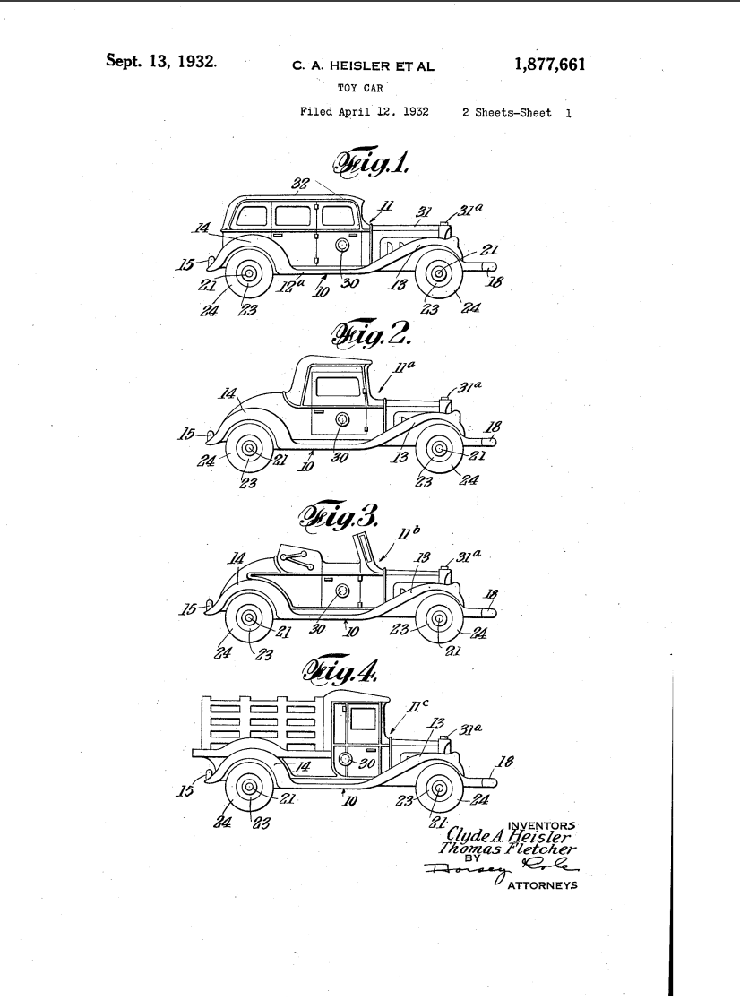
A crucial document is U.S. Patent No. 1,877,661, titled “Toy Car.”
The patent was invented by Clyde A. Heisler and Fletcher Thomas, filed on April 12, 1932, and issued on September 13, 1932.
Most importantly, the patent was assigned to:
A. C. Williams Co.
The patent describes a toy automobile built around an interchangeable system in which multiple vehicle bodies could be mounted to a common chassis.
The design contemplated several body styles, including automobiles and trucks, and was specifically intended to make interchangeability simple enough for children while keeping manufacturing practical.
The concept was not merely theoretical.
Surviving interchangeable A. C. Williams automobile sets correspond closely to the patented design.
The patent therefore establishes that A. C. Williams was still participating in the development of new toy automobiles in 1932.
Patent Citation
Clyde A. Heisler and Fletcher Thomas, “Toy Car,” U.S. Patent No. 1,877,661, filed April 12, 1932, issued September 13, 1932, assigned to A. C. Williams Co.
The patent and drawings can be examined through Google Patents.
A 1934 Advertisement Strengthens the Case
Patent evidence alone establishes design activity, but surviving advertising goes further.
An original paper advertisement dated 1934 survives advertising A. C. Williams toy automobiles.
The advertisement has been described in the collectibles market as promoting a red coupe and a two-tone green roadster.
That is important because it independently demonstrates commercial promotion of A. C. Williams toy automobiles more than a decade after the frequently repeated 1923 cutoff.
A surviving market record also documents what is described as an original 1934 A. C. Williams car-and-truck catalog.
Although the complete contents of that catalog have not yet been examined, its existence provides additional evidence that A. C. Williams continued marketing toy vehicles during the mid-1930s.
Taken together, the evidence is compelling:
1932: A new toy-car design is patented and assigned to A. C. Williams.
1934: A contemporary advertisement promotes A. C. Williams automobiles.
1934: A surviving auction record documents an A. C. Williams car-and-truck catalog.
The old 1923 ending date therefore appears to be an oversimplification, at least when applied to the company's toy-vehicle business as a whole.
A more cautious and evidence-based statement is that A. C. Williams continued producing or developing cast-iron toys into the 1930s.
A. C. Williams Toy Banks
Banks formed another major component of the company's toy output.
Cast-iron still banks were enormously popular in the late nineteenth and early twentieth centuries. They combined play with the Victorian and Progressive Era ideal of teaching children thrift.
A. C. Williams produced banks in a wide variety of forms.
These included animals, people, architectural forms, and other subjects.
The 1901 toy-bank patent confirms direct company involvement in the design of these products.
The approximately 1910 trade catalog provides even stronger evidence of the importance of the category, with nearly thirty pages reportedly devoted to banks.
That makes A. C. Williams not merely a toy-vehicle maker but an important participant in the broader American cast-iron bank industry.
Smithsonian Objects and Institutional Evidence
A. C. Williams products are represented in the collection of the Smithsonian's National Museum of American History.
The Smithsonian holds examples of A. C. Williams household and miniature products, including irons and other cast goods.
One particularly valuable object is a detachable-handle flatiron dating approximately from 1886 to 1892, during the company's Chagrin Falls period.
The Smithsonian identifies A. C. Williams as succeeding J. W. Williams Co. and J. W. Williams & Son and connects the company's relocation to Ravenna with the destructive factory fires of 1889 and 1892.
That institutional documentation helps anchor the company history outside the antique and toy-collecting marketplace.
It also illustrates the continuity between the company's household hardware and later toy production.
A. C. Williams understood cast iron long before it understood toy cars.
That industrial experience was its competitive advantage.
Adam Clark Williams: More Than a Toy Manufacturer
Adam Clark Williams was not simply the owner whose name appeared on the company.
He was an active industrialist, inventor, and civic figure.
Born in Chagrin Falls on January 22, 1848, Williams spent most of his adult life developing the family foundry.
Historical sources record that he served two terms as mayor of Chagrin Falls and spent approximately nine years on the town council.
He was also personally involved in product innovation.
In addition to toy-related patents, Williams received patents connected with sad irons and other manufactured goods.
A 1911 patent for an improved detachable sad-iron handle illustrates the mechanical thinking that characterized the company.
The mechanism was designed to reduce heat transfer and improve the durability and operation of the removable handle.
This combination of foundry expertise, mechanical experimentation, and willingness to diversify helps explain how a nineteenth-century ironworks evolved into a major twentieth-century toy manufacturer.
Adam Clark Williams died in 1932, the same year the interchangeable toy-car patent was filed and granted.
How A. C. Williams Toys Were Made
Like other American cast-iron toy manufacturers, A. C. Williams relied on the basic technology of the foundry.
Patterns were used to create molds, molten iron was poured into the mold cavities, and the resulting castings were cleaned and assembled.
Vehicle bodies were often cast in separate halves.
The parts could then be joined, fitted with axles and wheels, and painted.
The manufacturing technique produced toys that were remarkably durable.
It also produced variation.
Collectors encounter differences in casting detail, wheel type, paint scheme, body construction, and accessory configuration.
Some variations reflect production changes over time.
Others reflect the practical realities of factory manufacturing, including changes in suppliers, molds, and available components.
Identifying A. C. Williams Toys
Identification can be straightforward when a toy carries a manufacturer's name, but many early cast-iron toys are unmarked or only partially marked.
Attribution often requires considering several factors together:
Casting style.
A. C. Williams used characteristic body forms and casting techniques that experienced collectors learn to recognize.
Construction.
How body halves are joined, how axles are mounted, and how wheels are attached can provide clues.
Wheel design.
Wheel style is frequently useful in differentiating manufacturers and production periods.
Paint schemes.
Original color combinations can sometimes be matched to known cataloged examples.
Dimensions.
Even small dimensional differences can separate similar models made by competing companies.
Catalog evidence.
Original catalogs remain the strongest evidence when an exact model can be matched to a period illustration.
Patent drawings.
For certain designs, patent illustrations provide unusually strong documentation.
Identification should rarely rest on a single feature.
Hubley, Arcade, Kenton, A. C. Williams, and other American manufacturers frequently produced toys depicting similar real-world subjects.
Correct attribution therefore requires comparison rather than assumption.
Original Paint Matters
For collectors, original paint is one of the most important factors affecting desirability.
Cast-iron toys were meant to be played with.
As a result, surviving toys commonly exhibit:
- paint loss
- scratches
- chips
- oxidation
- worn wheels
- bent axles
- replaced hardware
Wear is not necessarily undesirable.
A toy with substantial but clearly original paint can be more appealing to serious collectors than a brightly repainted example.
Modern repainting can obscure casting detail and erase evidence of original color schemes.
Collectors should therefore be cautious with cast-iron toys that appear unusually glossy, uniformly painted, or dramatically fresher than their mechanical components.
Reproductions and Misidentified Toys
Cast-iron toys have been reproduced for decades.
Some reproductions are decorative objects never intended to deceive.
Others can be misleading when age, wear, or inaccurate attribution is added later.
Collectors should pay attention to casting sharpness, surface texture, fasteners, wheel construction, paint, and overall wear patterns.
Original castings generally exhibit a level of detail and consistency that poorly made reproductions lack.
Artificial aging often looks different from genuine decades of handling.
When an expensive toy is involved, attribution should be supported by catalog evidence, accepted reference works, or comparison with documented examples.
Why A. C. Williams Matters
A. C. Williams occupies an important place in American toy history because its story mirrors the development of American manufacturing itself.
The company began in the age of local iron foundries.
It produced practical household and agricultural castings.
It survived fire, relocation, and industrial change.
Then it adapted its skills to a new mass consumer market: children's toys.
Its miniature automobiles reflected America's fascination with the automobile.
Its tractors reflected the mechanization of agriculture.
Its airplanes captured enthusiasm for aviation.
Its banks continued a nineteenth-century tradition of teaching thrift through play.
And its later interchangeable automobile system shows that the company continued experimenting rather than simply repeating old designs.
The toys were miniature products of the same industrial culture that built America's machines, farms, roads, and factories.
Rethinking the A. C. Williams Timeline
One of the most useful lessons from studying A. C. Williams is how easily collector information can become simplified through repetition.
The commonly quoted 1893–1923 production range may describe a particular phase of the company's output, but it should not be used as an absolute ending date for A. C. Williams toy vehicles.
Contemporary evidence tells a different story.
In 1932, A. C. Williams was the assignee of a patent for a new interchangeable toy automobile.
In 1934, its automobiles were still being advertised.
A surviving record also identifies a 1934 A. C. Williams car-and-truck catalog.
The better conclusion is therefore not that every published date is wrong, but that the company's production history is more complicated than a single date range suggests.
That is precisely why original catalogs, patents, advertisements, museum collections, and contemporary historical records matter.
They allow collectors to move beyond repeated assumptions and reconstruct the history from the evidence itself.
A Company Worth Collecting—and Studying
Today, A. C. Williams toys remain appealing because they occupy several collecting worlds at once.
They are children's toys, industrial artifacts, automobile miniatures, examples of American folk-scale design, and products of one of the country's most important cast-iron manufacturing traditions.
A small A. C. Williams car may appear simple.
But behind it lies a story extending from an Ohio foundry in 1844, through devastating nineteenth-century fires, the rise of mass-produced consumer goods, the automobile age, and into the sophisticated toy market of the 1930s.
That history makes A. C. Williams more than another name cast into the underside of an old toy.
It makes the company an important chapter in the story of American manufacturing and play.
Research Notes and Selected Sources
Chagrin Falls Historical Society
Historical account of John Wesley Williams, Adam Clark Williams, the Chagrin Falls foundry, the 1889 and 1892 fires, and the company's early development.
History of the Western Reserve, 1910
Contemporary biographical and industrial history describing A. C. Williams, the relocation to Ravenna, corporate organization, family management, and company activities.
Smithsonian Institution, National Museum of American History
Collection records for A. C. Williams manufactured objects and company-history information associated with surviving examples.
A. C. Williams Company Catalog, c. 1910
The A.C. Williams Co. Manufacturers of Hardware House Furnishing Specialities and Toys, Forty-sixth Edition, Ravenna, Ohio, Republican Publishing Co., approximately 1910. 131 pages.
U.S. Patent No. 1,877,661
Clyde A. Heisler and Fletcher Thomas, “Toy Car,” filed April 12, 1932; issued September 13, 1932; assigned to A. C. Williams Co.
1934 A. C. Williams Advertisement
Surviving original paper advertisement promoting A. C. Williams toy automobiles, including a coupe and roadster.
1934 A. C. Williams Car-and-Truck Catalog
Surviving auction record documenting an original company catalog dated 1934.