
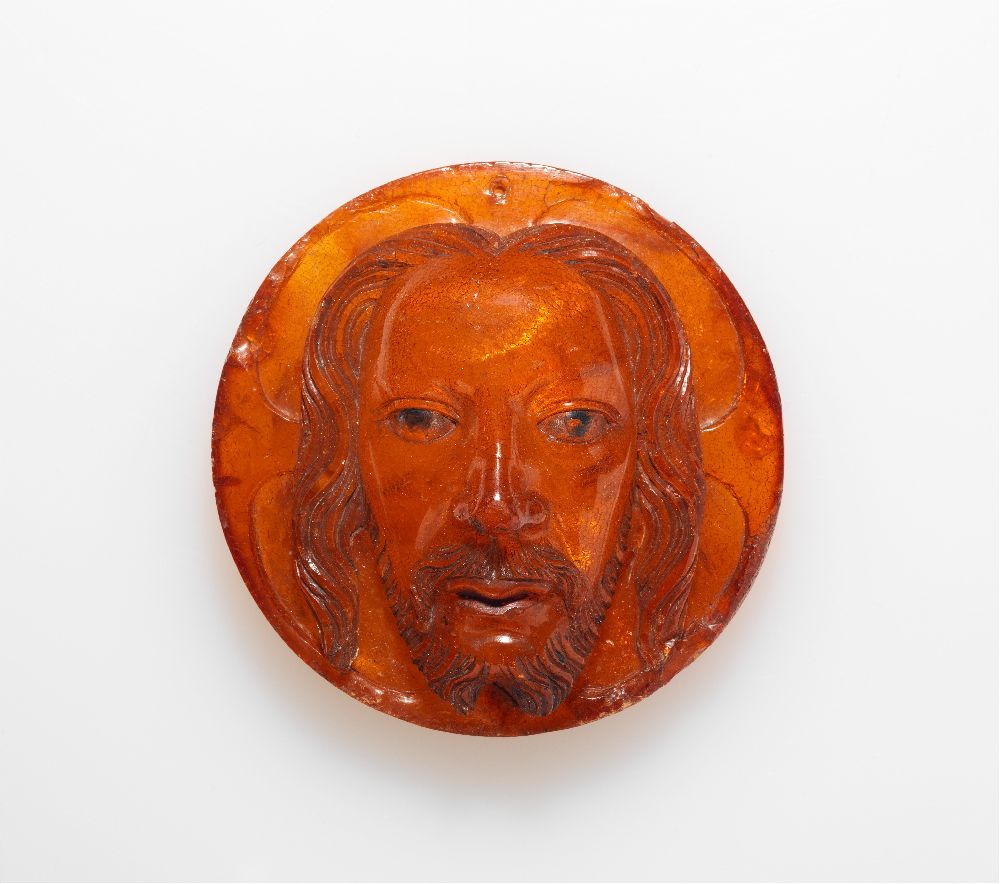
Baltic amber with traces of paint. Polish, ca. 1380-1400. Height: 3 1/4 inches (8.2 cm).
The Metropolitan Museum of Art , The Cloisters Collection, 2011 (2011.503). Public Domain (CC0).
What Is Amber?
Amber is fossilized tree resin, formed through chemical changes occurring over geological time. Unlike mineral gemstones, it is organic, relatively soft, and remarkably light. Baltic amber, among the best-known varieties, generally dates to the Eocene epoch, approximately 34–48 million years ago. Other important sources include the Dominican Republic, Myanmar, and Mexico.
Natural amber occurs in colors ranging from pale yellow and honey to deep orange, reddish brown, and nearly opaque cream. Greenish varieties and specimens exhibiting blue fluorescence are also known.
Its most important characteristics include low density, a Mohs hardness of approximately 2–2.5, and a refractive index generally around 1.54. Unfortunately, several imitation materials share enough of these characteristics to deceive an inexperienced buyer.
The Visual Characteristics of Amber in the Decorative Arts
Amber is not a visually uniform material. Its appearance varies considerably according to geological origin, internal structure, oxidation, natural inclusions, and subsequent treatment. Historical objects fashioned from genuine amber can look remarkably different from one another.
Transparent and translucent amber
Transparent amber may resemble colored glass, with relatively unobstructed transmission of light. Translucent amber permits light to penetrate the material but may contain clouds, internal veining, suspended particles, or other irregularities.
Colors range from pale champagne and golden honey to deep cognac and reddish brown. In carved objects, thinner sections may transmit light readily, while thicker portions appear almost opaque.
Such material has been employed in religious carvings, figurines, jewelry, snuff bottles, ornamental vessels, and other luxury objects. The transmission of light through a carving can greatly enhance its sculptural qualities, emphasizing contours and variations in thickness.
The Metropolitan Museum of Art's medieval Medallion with the Face of Christ, dating to approximately 1380–1400, illustrates the attractive translucency that can survive in amber for centuries. Transparency is not necessarily an indication of recent manufacture.
Cloudy and opaque amber
Genuine amber may also be cloudy, milky, or almost entirely opaque. Numerous microscopic gas bubbles and other internal structures can scatter light, producing an appearance quite unlike transparent amber.
Collectors frequently encounter the commercial terms butterscotch amber, beeswax amber, and egg-yolk amber. These describe visual characteristics rather than distinct mineralogical or chemical classifications.
Opaque amber can range from ivory and pale cream to rich mustard yellow and orange. Historical Chinese carvings frequently illustrate this appearance. Such material may superficially resemble ivory, horn, or early plastics.
Opacity is not evidence of inferior quality or inauthenticity. Certain opaque varieties have historically been highly prized.
Marbled and variegated amber
Some amber exhibits pronounced variations in color and transparency within a single piece. Cream-colored clouds, swirling orange and brown areas, and irregular transitions between opaque and translucent material can produce a marbled appearance.
These characteristics are particularly attractive in larger carvings, beads, and ornamental objects.
However, similar effects can be produced in pressed amber and synthetic resins. Marbling alone cannot establish whether a specimen is natural or reconstructed.
Red, cognac, and dark brown amber
Amber may naturally exhibit reddish or brownish coloration, but its color can also deepen through oxidation, exposure to light, and artificial heat treatment.
Historical objects sometimes possess a relatively dark exterior surrounding a lighter, more translucent interior. Existing chips, worn edges, and thinner carved sections may reveal differences in coloration.
The collector should distinguish between surface coloration and the underlying appearance of the material. Deep reddish-brown coloration is not necessarily evidence of great antiquity.
Surface oxidation, patination, and crazing
The appearance of amber changes with exposure to oxygen, light, and environmental conditions. Objects may develop a surface patina ranging from a subdued reddish coloration to a substantially darker, opaque crust.
Collectors may encounter:
Fine networks of surface cracks or crazing.
Darkening around recesses and carved details.
Diminished surface gloss.
Small areas of flaking or exfoliation.
Differences in color between exposed and protected surfaces.
The Getty Museum's examination of ancient carved amber documents substantial differences in preservation, including the formation of deteriorated surface layers that obscure the material's original translucency.
These characteristics may be consistent with age but cannot establish a particular date of manufacture. Environmental conditions have a considerable influence on the rate of deterioration.
Inclusions and internal features
Amber may contain particles of bark, plant material, insects, gas bubbles, natural flow lines, and internal fractures.
Viewed under transmitted light, these features can give a carving considerable visual depth and individuality. Dark inclusions may appear almost black against a translucent golden background.
The presence of inclusions is not necessarily evidence of authenticity, however. Copal may contain natural inclusions, and synthetic resins can incorporate foreign material deliberately.
Clarified and heat-treated amber
The deliberate alteration of amber's appearance is not exclusively a modern practice. Historical accounts describe methods of improving its transparency dating back to antiquity.
Modern heat treatments can increase clarity, deepen coloration, and produce distinctive circular internal fractures commonly called sun spangles. Other treatments can modify the appearance of opaque amber or produce greenish and reddish coloration.
Treated amber remains genuine amber, although the nature and extent of treatment may influence its desirability and value.
Visual Identification at a Glance
Appearance | Possible genuine amber characteristic | Potential substitutes |
|---|---|---|
Clear golden yellow | Transparent amber | Copal, glass, acrylic |
Translucent honey or cognac | Natural or oxidized amber | Copal, phenolic resin, epoxy |
Opaque cream or yellow | Beeswax or bone amber | Catalin, celluloid, modern plastic |
Marbled yellow and brown | Naturally variegated amber | Pressed amber, molded resin |
Deep reddish brown | Natural coloration, oxidation, or treatment | Faturan, Bakelite, colored resin |
Dark surface with lighter interior | Surface oxidation or treatment | Artificially aged resin |
Circular internal fractures | Heat-treated amber | Synthetic resin with simulated features |
Embedded organic material | Natural inclusions | Copal, synthetic resin |
Examining a Carved Amber Object
Collectors examining a figurine, snuff bottle, religious carving, or other decorative object should observe it under both reflected and transmitted light. A small LED flashlight directed through thinner sections can reveal internal characteristics that are otherwise invisible.
Particular attention should be paid to existing chips, the underside, carved recesses, and areas of surface wear. These locations may reveal differences between surface patination and the underlying material. A 10x loupe is also useful for examining tool marks, possible mold seams, joins, and internal features.
Ultimately, neither transparency nor opacity is a reliable indication of authenticity or age. Documented ancient amber objects survive in remarkably transparent condition, while comparatively recent objects may be entirely opaque.
The collector must distinguish between four separate questions:
Is the material genuine amber?
Is it naturally occurring or reconstructed?
Has it been treated to modify its appearance?
When was the object fashioned?
The first three are principally questions of material analysis. The fourth requires historical, stylistic, and technological examination.
The Principal Amber Substitutes
1. Copal and other young natural resins
Copal is perhaps the most deceptive substitute because it is itself natural tree resin, but it has not undergone the same degree of fossilization as amber. Copal may be thousands or even millions of years old, depending on its geological circumstances.
It can resemble amber in color, transparency, density, and ultraviolet fluorescence.
Identification: Many copals become tacky when exposed to acetone, whereas fully fossilized amber ordinarily does not. However, solvent testing can damage the object, and treated copal may resist this test. Infrared spectroscopy is considerably more reliable.
2. Bakelite, Catalin, and Faturan
Phenolic resins became important amber substitutes during the early 20th century. Bakelite and Catalin were particularly suitable for jewelry and decorative objects because they could be manufactured in attractive translucent colors.
Faturan, associated especially with collectible prayer beads, belongs to the broader family of phenolic resin materials. These older plastics may have considerable collectible value independent of their resemblance to amber.
Identification: Phenolic resins can sometimes be identified by characteristic reactions to specialized chemical tests, along with differences in density and fluorescence. Many are heavier than amber. A positive chemical reaction is not, by itself, proof of a particular brand or formulation. FTIR analysis provides a much more dependable identification.
3. Celluloid and cellulose acetate
Early cellulose-based plastics were manufactured in translucent yellow and amber-colored varieties. They appear in jewelry, handles, buttons, and decorative articles.
Identification: Mold seams, surface deterioration, and distinctive aging characteristics can provide clues. Celluloid may develop yellowing, cracking, or chemical deterioration. Infrared spectroscopy distinguishes cellulose-based plastics from natural fossil resin.
4. Acrylic, polyester, and epoxy resins
Modern synthetic resins can imitate amber remarkably well. Manufacturers can reproduce cloudiness, internal fractures, and even suspended insects.
Identification: Magnification may reveal molded surfaces, artificial bubbles, or unnatural inclusions. Ultraviolet responses are variable, and some plastics can pass a saltwater flotation test. FTIR spectroscopy identifies the polymer family and distinguishes these materials from natural amber.
5. Glass
Yellow, orange, and reddish-brown glass has long been used to imitate amber, particularly in beads and inexpensive jewelry.
Identification: Glass ordinarily feels noticeably heavier and cooler than amber, is harder, and generally sinks in concentrated saltwater. Gas bubbles and characteristic internal features may be visible under magnification. A refractive-index measurement can provide additional confirmation.
6. Pressed or reconstructed amber
Pressed amber, sometimes called ambroid, is manufactured by consolidating small fragments or particles of genuine amber through heat and pressure.
Unlike plastic, the starting material is genuine amber, but the resulting object is manufactured rather than a single natural piece.
Identification: Magnification may reveal boundaries between fragments, flow structures, or unusual internal features. FTIR can establish that the material contains amber, but additional microscopic examination may be necessary to determine whether it has been reconstructed.
7. Composite amber and artificial inclusions
Some objects combine genuine amber with synthetic resin, while others contain deliberately inserted insects or plant fragments. A genuine piece of amber can therefore possess an artificial or altered inclusion.
Identification: Microscopic examination may reveal joining lines, inconsistent internal structures, or suspicious inclusions. Advanced spectroscopy and other laboratory techniques may be necessary to identify composite construction.
Practical Tests for Identifying Amber
No single inexpensive home test can reliably distinguish amber from every possible imitation. Several tests used together can nevertheless eliminate many substitutes.
Test | Expected result for amber | Reliability |
|---|---|---|
Saltwater flotation | Usually floats in sufficiently concentrated saltwater | Moderate |
Ultraviolet light | Often fluoresces blue, greenish, or yellowish | Moderate |
Static electricity | May attract small paper fragments after rubbing | Low |
Acetone | Usually unaffected by brief contact | Useful for copal, but damaging |
Magnification | May reveal natural flow lines and inclusions | Moderate |
Refractive index | Approximately 1.54 | High when combined with other tests |
Hot needle | Characteristic resinous odor | Destructive; not recommended |
FTIR spectroscopy | Identifies characteristic molecular absorption patterns | Very high |
The saltwater test
Amber has a specific gravity generally around 1.05–1.10, making it sufficiently light to float in concentrated saltwater. Glass and most phenolic plastics sink.
Unfortunately, copal and certain modern plastics may also float. The test therefore establishes only that the specimen has a relatively low density. It does not establish that it is amber.
Use only on loose, unmounted objects suitable for immersion; saltwater may damage metal fittings or enter fractures.
Ultraviolet fluorescence
A long-wave UV lamp, typically operating at 365 nanometers, is particularly useful for preliminary examination. Many natural ambers exhibit bluish or greenish fluorescence, although the response varies with origin, condition, and treatment.
Some plastics also fluoresce. Conversely, coatings or treatments can alter amber's natural response.
A revealing GIA investigation of an apparently uniform rosary identified 71 amber beads and 31 Bakelite beads. The materials exhibited different UV responses, and their identities were confirmed by infrared spectroscopy.
Static electricity
Amber's ancient association with electricity comes from its ability to acquire an electrostatic charge when rubbed with cloth.
A charged piece may attract tiny paper fragments or other lightweight objects. Unfortunately, many plastics exhibit precisely the same behavior. This is an interesting demonstration, not an authentication test.
Acetone and hot-needle tests
Acetone has traditionally been used to distinguish amber from copal, since many young resins soften or become sticky in its presence. However, treatments and coatings can complicate the reaction, while certain plastics also react to solvents.
The hot-needle test produces a resinous smell from amber, but it permanently damages the specimen. Heating unidentified plastics can also release hazardous fumes.
Neither test is recommended for valuable jewelry, carvings, or historical objects.
What Definitively Identifies Amber?
For a valuable specimen, the preferred method is Fourier-transform infrared spectroscopy (FTIR), often performed using attenuated total reflectance (ATR-FTIR).
This technique examines how the specimen absorbs infrared radiation at different wavelengths. Its molecular absorption pattern can be compared with established reference spectra for amber, copal, and synthetic polymers.
FTIR can ordinarily distinguish genuine fossil resin from most substitutes without requiring destructive sampling. It may also help characterize amber's geological origin.
However, identifying the material is not necessarily the same as establishing that an object is untreated, unreconstructed, or of a particular age. Treated copal can sometimes produce misleading spectral similarities, and composite objects may require testing in multiple locations. Advanced laboratories may supplement FTIR with Raman spectroscopy, nuclear magnetic resonance (NMR), or other analytical methods.
For a meaningful certificate, the laboratory should ideally state:
Whether the material is amber, copal, or a synthetic substitute.
Whether evidence of treatment or reconstruction was detected.
Whether the object contains multiple materials.
Whether its geographical origin can be established, if relevant.
A Collector's Conclusion
Amber's greatest identification problem is not that imitations always look convincing. It is that many substitutes share some of amber's physical properties.
Glass is generally easy to eliminate. Copal and certain synthetic polymers present substantially greater difficulties. Pressed amber adds another complication because it is composed of genuine fossil resin but has undergone manufacturing processes.
For inexpensive objects, careful inspection, ultraviolet examination, and density testing may provide sufficient confidence for a qualified attribution. For valuable jewelry, carvings, or specimens with unusual inclusions, laboratory spectroscopy is the appropriate standard.
Ultimately, the burden of identification should increase with the object's claimed rarity and value. An attractive honey-colored carving may be worth owning regardless of its material, but it should not command the price of fine natural amber without convincing evidence of authenticity.
References and Further Reading
Gemological Institute of America, Plastic Amber Imitation in a Rosary (2017).
Gemological Institute of America, Identification of Natural, Reconstructed, and Imitation Root Amber (2022).
Gemmological Association of Australia, Is It Copal or Amber?
J. Paul Getty Museum, Ancient Carved Ambers: Technical Essay.