
The National Geographic Society was founded in Washington, D.C., on January 27, 1888, by a group of scientists, explorers, educators, and government officials interested in the systematic study and dissemination of geographical knowledge. Among its early leaders were Gardiner Greene Hubbard, the Society's first president, and his son-in-law Alexander Graham Bell, who succeeded him in 1898.
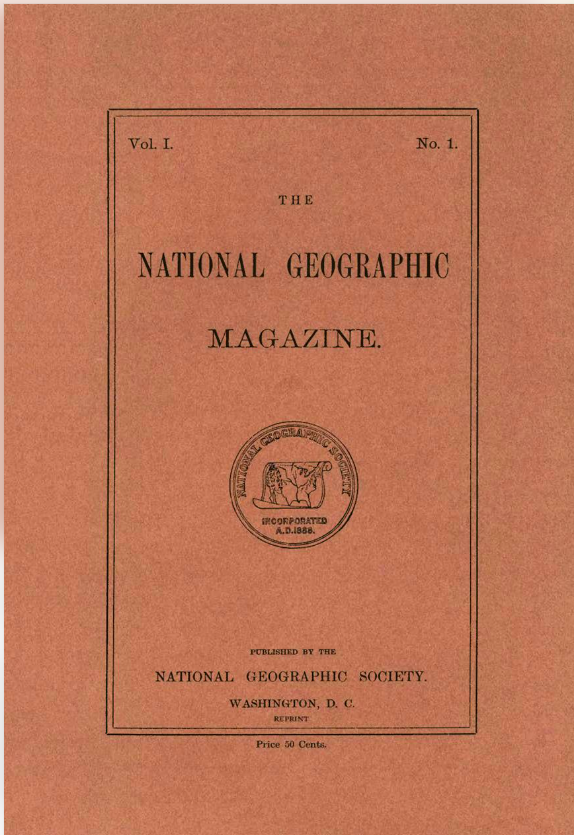
The Society's first publication, The National Geographic Magazine, appeared in October 1888. It bore little resemblance to the illustrated magazine familiar to twentieth-century readers. Its unadorned, terra-cotta-colored wrapper enclosed scholarly articles concerned with geography, geology, exploration, meteorology, and other scientific subjects. Maps and diagrams were included, but photographs were not yet the defining feature of the publication.
The first issues were produced for a comparatively small membership, with publication initially irregular rather than monthly. The journal was an instrument for exchanging knowledge among specialists rather than a popular commercial enterprise. That distinction helps explain why surviving copies of the first several volumes are so scarce today.
Early National Geographic covers illustrate the transformation from a modest scientific journal into the familiar yellow-bordered periodical.
A central figure in that transformation was Gilbert Hovey Grosvenor, who joined the magazine in 1899 and became its editor. Supported by Alexander Graham Bell, Grosvenor encouraged an editorial approach that made geography understandable and interesting to a broad readership. The magazine increasingly emphasized accessible writing, illustrations, and eventually photography, without entirely abandoning its scientific origins.
A particularly important turning point occurred in 1905, when photographs of Tibet demonstrated the extraordinary appeal of visual exploration. The magazine began allocating substantially more space to photographic illustration. By the opening years of the twentieth century, National Geographic was evolving from a specialist journal into a general-interest publication distinguished by its ability to show readers places they might never visit.
The Yellow Border and the Growth of Circulation
The famous yellow border appeared in 1910. Its adoption gave the magazine a readily identifiable appearance, particularly when accumulated copies stood together on a shelf. The design eventually became one of the most recognizable trademarks in American publishing.
The magazine's growth was remarkable. Circulation had reached approximately 170,000 by 1913 and one million by 1926. During the latter half of the twentieth century, American circulation climbed into the millions, reaching approximately twelve million during the late 1980s.
This expansion fundamentally altered the magazine's future as a collectible. Early issues had been printed in quantities appropriate to a small scientific society; later ones were produced in enormous numbers for a national and eventually international audience.
Photography was largely responsible for this success. The magazine became an important showcase for advances in photographic reproduction and the visual documentation of the world. Natural-color Autochrome photographs appeared in 1914, and in 1927 the magazine published pioneering natural-color underwater photographs made by William Longley and Charles Martin. These achievements made National Geographic an important historical source for photographic technology as well as geography and exploration.
Its editorial influence extended beyond scientific discovery. Generations of American readers encountered foreign countries, unfamiliar cultures, archaeology, wildlife, and natural wonders through its pages. Its depictions were not always neutral: the magazine's treatment of colonialism, race, and non-Western societies often reflected the assumptions of its period. Consequently, early issues are valuable historical documents not only for the subjects they describe but also for what they reveal about American attitudes toward the wider world.
National Geographic in the Television and Digital Ages
During the postwar decades, National Geographic increasingly became a multimedia institution. Its documentaries and television programming carried its familiar combination of exploration, science, wildlife, and photography beyond the printed page. The magazine itself continued to evolve, eventually introducing cover photographs in 1959, replacing the comparatively restrained cover treatment that had characterized earlier decades.
The June 1985 issue featuring Steve McCurry's portrait of an Afghan refugee girl became one of the most recognizable magazine covers ever published. It demonstrated how an individual photograph could acquire an enduring cultural identity independent of the article it accompanied.
The June 1985 cover is among the most recognizable in the magazine's history. Its historical importance is considerable, although surviving copies are abundant.
With the arrival of the internet, the Society established a substantial digital presence, providing new ways to distribute photography, documentary material, maps, and scientific reporting. The magazine nevertheless faced the same economic pressures affecting other printed periodicals: declining advertising revenue, changing reading habits, and the migration of audiences to digital media.
A major corporate change came in 2015, when the National Geographic Society established National Geographic Partners with 21st Century Fox, placing its commercial media operations in a joint venture. Disney acquired Fox's controlling interest in that venture in 2019. The nonprofit Society continued its work in exploration, education, and research, while the commercial enterprise operated the magazine and associated media properties.
In 2023, the magazine underwent further editorial reductions and announced the end of American newsstand sales beginning in 2024. Contrary to occasional reports suggesting that the magazine itself had ceased publication, National Geographic continues to publish a printed subscription edition in 2026, alongside its digital content. The publisher currently advertises twelve monthly print issues for subscribers.
The modern magazine is thus part of a much larger media enterprise, but it retains a continuous publishing history stretching back to 1888.
Why Are Some National Geographic Magazines Valuable?
The value of an old magazine is governed by several interacting considerations: original production, survival, collector demand, historical importance, completeness, and condition. National Geographic provides an excellent illustration of these principles because its early scarcity contrasts so dramatically with the abundance of its later publications.
The first 36 issues, published during the Society's formative years, occupy a particularly desirable position in the collector market. They were produced for a very small audience, at a time when the magazine was neither widely distributed nor ordinarily preserved as a popular collectible. Many surviving copies eventually entered institutional libraries, where individual issues were bound together or original wrappers were discarded.
The situation changed as circulation increased. By the 1920s, National Geographic had become a household institution, and subscribers frequently saved their magazines. Entire decades of issues accumulated in attics, bookcases, and basements. The yellow borders that made the magazines attractive as a uniform library also encouraged their preservation.
This has produced an unusually unfavorable supply-and-demand relationship for many later issues. A magazine from 1940 may have considerable historical interest, yet the supply of surviving examples can easily exceed the number of collectors who want one.
Age is important, but rarity and demand are decisive. A complete early issue with its original maps and wrappers may be worth hundreds or thousands of dollars. A beautifully preserved issue from the 1960s, although more than half a century old, may be worth only a few dollars.
What Have Rare National Geographic Magazines Actually Sold For?
Perhaps the most useful evidence comes from recorded auction transactions rather than advertisements offering old magazines at ambitious prices.
On April 2, 2026, Blue Box Auction Gallery of Norfolk, Virginia, conducted a specialized sale of early National Geographic publications. Several of the earliest original issues achieved remarkable prices.
Issue | Recorded price realized |
|---|---|
April 1890, Volume II, No. 1 | $4,255 |
July 1890, Volume II, No. 3 | $4,505 |
March 1892, Volume IV, No. 1 | $7,025 |
March 31, 1892, Volume IV, No. 4, with map | $6,015 |
Blue Box Auction Gallery, April 2, 2026. Figures are reported hammer prices, excluding buyer's premium.
The original October 1888 first issue is another important prize. The National Geographic Collectors Corner valuation guide, revised in September 2026, records a verified sale of slightly more than $6,000 for that issue. It also documents exceptional transactions involving other early numbers. These figures establish that a serious, high-value collector market exists for the earliest editions.
Yet it would be a mistake to extrapolate these prices across an entire decade. At the same April 2026 auction, an original January 1896 issue retaining its supplementary map realized only $10, despite a published estimate of $150–$300. Other original 1896 issues sold for similarly small amounts. Such results illustrate the unevenness of a relatively specialized market, particularly when many related issues are offered together.
Auction prices can also reflect bidder competition, the number of comparable examples available, and the circumstances of a particular sale. An exceptional result is evidence of what one example achieved, not a guarantee that another will command the same price.
A Particularly Interesting Exception: April 1913
Not every desirable issue belongs to the nineteenth century. One noteworthy example is April 1913, a magazine prized for its contents, scarce supplementary map, and difficulty of finding complete examples with intact bindings.
According to the September 2026 Collectors Corner guide, the average of the three highest recorded sales for this issue with its supplement was approximately $450.65. The figure represents a selective high-end historical benchmark, not the average price of every example sold.
This illustrates a fundamental principle of periodical collecting: a particular issue can become unusually valuable when desirable content, vulnerable construction, and missing inserts make complete copies difficult to obtain.
The Importance of Original Maps and Supplements
Maps are among the most interesting and potentially important components of National Geographic collecting. The magazine's identity has always been closely connected with cartography, and maps appeared in the publication from its first issue in 1888.
The Society initially relied on maps produced outside its own organization. In 1915 it established a dedicated cartographic department, and the May 1918 supplementary map, The Western Theatre of War, became the first large pull-out map produced by its own mapmakers.
That map was intended to help readers understand the geography of the Western Front during World War I. Its detailed depiction of towns, roads, and strategic geography marked an important stage in the development of the Society's cartographic program.
Examples of the Society's historical cartography, including First and Second World War maps. Such supplements are of interest to collectors of maps, military history, and the magazine itself.
During World War I, maps were especially important because the American public was attempting to understand events in unfamiliar European territories. The August 1914 map of Europe and the Balkan states, published as the war began, is an important example of how a geographical publication could respond to contemporary events.
After the war, the Society's maps documented changes in international boundaries, including the political rearrangement of Europe following the Paris Peace Conference. In 1922, its cartographic department issued its first general reference map of the world.
By World War II, National Geographic had become a significant producer of maps for both civilian and official purposes. Its July 1944 supplement, Germany and Its Approaches, was useful enough to be employed by Allied military planners. The Society supplied hundreds of thousands of maps to wartime government agencies.
Which Maps Are Collectible?
Not all maps are equally desirable. Among the more interesting categories are early nineteenth-century supplements, maps associated with major conflicts, maps showing countries before or after significant territorial changes, and specialized maps concerning exploration, railroads, natural resources, or other historically important subjects.
Early maps may be valuable partly because the magazines with which they were issued are scarce. Later maps may attract collectors independently of the magazine, particularly if they illustrate a compelling historical subject.
Condition and completeness are especially important. A map that has remained folded within its original magazine may have survived with relatively little exposure to light, although long-term folding can produce splits and weakening along the creases. Maps that were pinned to walls, mounted with adhesive, laminated, or repeatedly unfolded may suffer damage that substantially reduces their desirability.
Collectors should distinguish ordinary maps printed within articles from separately issued folding supplements. Both may be historically interesting, but the latter are frequently the more significant consideration when determining whether an issue is complete.
Should National Geographic Maps Be Removed and Sold Separately?
In many ordinary twentieth-century issues, the supplementary map may have as much commercial appeal as the parent magazine, and sometimes more. Dealers occasionally sell these maps individually, especially when the magazines themselves are common.
That approach is not necessarily advisable for rare early issues. Removing an original map from a scarce nineteenth-century magazine can materially reduce the value of the complete publication. In some cases, a complete magazine with its correct original map is more desirable than the components sold individually.
A useful rule is to evaluate the magazine and map together before separating them. For early and scarce issues, preservation of the original association is generally preferable. For abundant later publications, individual map sales may be more commercially practical.
There is also a distinction between historic maps as originally issued and modern reproductions. Reproductions can be attractive decorative objects, but they ordinarily lack the historical and collecting significance of contemporary originals.
Original Issues Versus Reprints
One of the greatest hazards in collecting early National Geographic magazines is confusing reproductions with original editions.
The National Geographic Society itself recognized the scarcity of its early publications and undertook substantial reprinting projects. In 1922 it reprinted two numbers from the first volume, and in 1964 it reproduced the magazine's first twenty years, covering 1888 through 1907. An additional reproduction of the first issue appeared in 1975.
These were authorized Society publications, not fraudulent copies. They are historically interesting and have their own collector market. Nevertheless, their values must be distinguished from those of original nineteenth-century editions.
Authorized reproductions of early issues were published for collectors and libraries. Careful examination of printing details and reprint markings is essential.
The Society's contemporary explanation of the 1964 project stated that covers and supplements would carry an identifying REPRINT marking. Other differences in paper, printing, dimensions, and construction can help establish an issue's status.
However, early reprints and reissued material are more complicated than a single identification rule might suggest. Specialized collector references document variations that require examination of individual issues. Consequently, the absence of an obvious reprint notice should not, by itself, be regarded as proof of originality.
The difference in value can be substantial. At the April 2026 Blue Box auction, the 1896–1901 bound reprint volumes realized $500 as a group, and the 1902–1907 reprint volumes realized $310. Individual examples of early reprints sold for as little as $10, while authentic early originals at the same sale reached several thousand dollars.
A collector encountering an apparent 1888 or 1890 issue should therefore establish authenticity before assigning a high valuation. This is particularly important when buying old collections at estate sales or from nonspecialist sellers.
What Increases or Diminishes Value?
Several factors determine the desirability and market value of individual issues, bound volumes, and collections.
Originality and rarity. An authentic early printing is normally more desirable than a later reproduction. Low original circulation and a limited surviving population are especially important, although rarity without collector demand does not necessarily produce a high price.
Original covers and advertisements. Individual issues retaining their original wrappers are generally preferred. Advertisements are also historical documents, and their preservation may be important to collectors studying businesses, products, and commercial culture of the period.
Maps and other supplementary material. A missing folding map can significantly diminish the value of an early issue. Other originally issued inserts, plates, charts, or supplements should also be checked.
Condition. Torn covers, detached pages, water staining, foxing, brittle paper, missing sections, and deteriorated bindings detract from desirability. Minor evidence of age may be acceptable in exceptionally rare material, while common magazines typically need to be in excellent condition to attract interest.
Historical or topical significance. Issues associated with major expeditions, photographic achievements, wars, archaeology, or landmark discoveries may attract buyers beyond the regular magazine-collecting community. That additional demand can be important, although the number of surviving copies remains a controlling factor.
Completeness of a run. A long uninterrupted sequence can be appealing to a specialist collector, but not every collection is worth more when sold intact. A complete run of common postwar magazines may be difficult to market because of shipping expenses and storage requirements.
Binding. Professionally bound annual volumes can be attractive and protective, but binding may involve trimming the magazines and removing wrappers, advertisements, or maps. A finely bound volume should not automatically be assumed more valuable than its original individual issues. Collector preferences and the survival of the original material are decisive.
Provenance and association. A documented association with an important explorer, scientific figure, or historically significant institution may enhance value. Ordinary subscription labels, ownership inscriptions, and library markings do not ordinarily confer such a premium; in many cases, they detract from condition.
A good example of the complexity is the early twentieth-century period. Issues from 1908 through 1917 can be considerably more difficult to obtain in fine condition than casual collectors suppose. They are too recent to share the extraordinary rarity of the original scientific journal, but early enough that intact wrappers, maps, and supplementary material may be scarce. The specialized Collectors Corner research identifies this period as deserving closer attention than the ordinary postwar magazines.
Are Mid-Twentieth-Century National Geographics Worth Saving?
The magazine's enormous twentieth-century circulation means that most issues from the 1930s onward have little individual resale value. Nevertheless, they can remain desirable to readers, decorators, historians, and collectors specializing in particular subjects.
The December 1969 issue, associated with the Apollo 11 moon landing, and the June 1985 issue with Steve McCurry's celebrated Afghan girl cover are examples of historically memorable publications. Yet fame is not the same as rarity. Both appeared during periods when the magazine was produced in very large quantities, and many copies survive.
The same distinction applies to special commemorative issues, wildlife features, and reports on important discoveries. Their contents may be fascinating and historically useful, without creating a substantial premium in the secondary market.
For an owner attempting to evaluate a collection, the publication date is therefore the most useful starting point. The following broad classifications offer practical guidance, although individual issues and actual sales can differ substantially.
Period | General collector-market characteristics |
|---|---|
1888–1895 | Principal rarities; selected originals may sell for thousands |
1896–1907 | Specialized collector interest; values vary considerably by issue and completeness |
1908–1919 | Desirable exceptions, especially intact issues with scarce maps |
1920–1939 | Usually modest individual values; special subjects and maps may attract interest |
1940–1979 | Generally abundant; most sell inexpensively, if at all |
1980–present | Mostly inexpensive; historic covers may attract niche demand |
These are not fixed price schedules. The verified 2026 auction results demonstrate that even an original nineteenth-century example can sell for considerably less than anticipated.
For common postwar issues, individual retail prices of a few dollars are frequently more realistic than the substantial figures sometimes encountered in online listings. Bulk collections may have little or no practical resale value after allowing for the expense of handling, packing, and transportation.
How to Evaluate an Inherited Collection
When confronted with a large collection of National Geographic magazines, it is seldom necessary to examine every issue immediately. An initial inspection should establish the earliest publication date, whether the collection includes pre-1920 issues, and whether any early volumes retain their original wrappers and supplements.
Particular attention should be given to maps. These are often folded inside the magazines and may be overlooked or inadvertently damaged. A careful inventory of the supplementary maps can be more productive than attempting to price hundreds of ordinary issues individually.
Early magazines should be handled gently. Paper and bindings may have become brittle, and an attempt to flatten an old map or force open a fragile volume can create damage that did not previously exist. Collectors should also avoid unnecessary cleaning, repairs using modern adhesive tape, or removal of original labels and inserts without understanding their significance.
Where a collection includes very early issues, it may be worthwhile to consult a knowledgeable periodical dealer, specialized collector, or auction house experienced in rare printed material. Establishing authenticity, identifying missing material, and comparing actual sales are more important than relying on generalized online price guides.
Conclusion: A Magazine Whose Cultural Importance Exceeds Its Average Market Value
The story of National Geographic is one of the great successes in American publishing. What began in 1888 as the modest journal of a scientific society became an international institution, helping define how generations of readers understood geography, exploration, photography, and the natural world.
Its influence was so extensive that it created an enormous archive of printed material preserved in American homes. That very success accounts for the modest monetary value of most surviving issues. The publications were too widely distributed, and too frequently saved, to become scarce merely through the passage of time.
Yet the market for original early editions demonstrates that important exceptions exist. The earliest issues, certain exceptionally complete publications, and scarce supplements can command substantial prices. Maps add another collecting dimension, connecting the magazines with the history of cartography, exploration, and international affairs.
For the collector, the lesson is straightforward: a familiar yellow border may contain a magazine worth only a dollar or two, but an earlier terra-cotta wrapper, an uncommon issue, or a complete magazine with a scarce original map can be an entirely different proposition.
The challenge is not simply to find old National Geographics, but to distinguish those that have survived in abundance from those that have survived against the odds.
References and Further Reading
1. National Geographic Society. About National Geographic Maps. Background on the Society's cartographic operations and history.
2. National Geographic. Explore 100 Years of National Geographic Pull-Out Maps. Illustrated historical survey of the magazine's supplementary maps.
3. National Geographic. How World War I Launched National Geographic's Mapmaking Tradition. History of the Society's developing cartographic program and its military applications.
4. National Geographic Collectors Corner. A Guide to Selling National Geographic Magazines, Revised September 2026. Extensive collector research with recorded sales, reprint data, and discussions of supplements and condition.
5. Blue Box Auction Gallery. Volume IV, No. 1, March 1892, April 2, 2026 sale. Documented auction price and condition for an important early original issue.
6. National Geographic Collectors Corner. A Guide to the National Geographic Magazine Reprints. Specialist guidance concerning authorized reproductions and variations.
7. National Geographic. Eight National Geographic Photos That Made History. Selected milestones in the history of magazine photography.
8. University of Pennsylvania, Online Books Page. National Geographic Archives. Links to digitized historical volumes useful for identifying issues and researching their contents.