
Before Lionel
The history of the American electric toy train becomes much less tidy once the clock is turned back before Lionel.
By the time Joshua Lionel Cowen began building electrical toys in New York around the turn of the twentieth century, a Cincinnati company called Carlisle & Finch had already put electrically driven miniature railways into commercial production. Its trains appeared in national advertising during the 1890s, and by 1900 the company's catalog showed not an isolated novelty but an entire miniature electrical world of railways, motors, dynamos and experimental apparatus.
Carlisle & Finch has consequently been described as the maker of the world's first electric toy train. The company itself uses that language today. It is a claim that needs qualification. Experimental electrically powered model railways predated the company, particularly in Europe, and "first electric train" can mean several different things: first experiment, first demonstration, first marketed product or first commercially significant production.
The more defensible claim is also the more interesting one. Carlisle & Finch was among the very first American firms—and quite possibly the first—to turn the electric toy railway into a manufactured consumer product sold in meaningful quantity.
That distinction places the company squarely at the beginning of the American electric-train industry without requiring us to erase earlier experiments. Carlisle and Finch
Two Electrical Engineers in Cincinnati
Carlisle & Finch did not begin as a toy company.
Robert S. Finch and Morten Carlisle were young electrical engineers working in Cincinnati during the period when electricity itself was still a comparatively new commercial technology. The business that became Carlisle & Finch originated in the Cincinnati operations of General Electric and initially concentrated on the repair of transformers, armatures, arc lamps and other electrical apparatus.
Company history dates the beginning of the partnership to 1893, with a move to larger quarters the following year. Repair work was useful, but the partners quickly concluded that a viable manufacturing business needed products of its own. Central Ohio River Business Association
Their backgrounds help explain what happened next.
Carlisle was trained as an electrical engineer at the Massachusetts Institute of Technology, while Finch had studied at the University of Cincinnati. Contemporary and later accounts place Carlisle in electrical railway work and Finch in lighting-related work. Whether that division can be traced neatly into every later invention is difficult to prove, but it fits the firm's two most important early product families remarkably well: electric railways and electric searchlights.
This was not a conventional toy maker that happened to install an electric motor. It was an electrical engineering concern that discovered that a miniature railway could be one of its products.
A Toy Railway in 1897
The strongest evidence for Carlisle & Finch's early position does not come from later recollections. It comes from advertising published while the trains were actually being made.
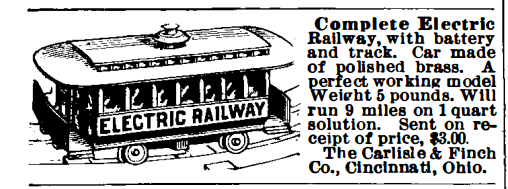
The May 22, 1897 issue of Scientific American carried a Carlisle & Finch advertisement for a complete electric railway. The set included a polished-brass car, battery and track. The car weighed five pounds, and the advertised price was $3.00. Survivor Library
That date matters.
It demonstrates that Carlisle & Finch was not merely experimenting with electric trains in 1897. It was offering a complete working system to the general public through one of the country's leading scientific publications.
By December of the same year, an advertisement in The Ladies' Home Journal showed that the product range was already expanding. Carlisle & Finch offered electric railways beginning at $3.50, a coal-mine train for $5, an inclined-plane railway for $4, and a water-power plant for $8. The electric railway was advertised as capable of running 150 feet per minute. Wikimedia Commons
The juxtaposition is revealing. A child's railway, a coal train, an incline and a miniature generating plant were all being marketed together. Carlisle & Finch was selling entertainment, but it was also selling an introduction to electricity.
What Did One Cost in Real Terms?
Historical prices become misleading if they are simply converted into modern dollars. A better question is how much work was required to buy the object at the time.
Historical Statistics of the United States gives average annual earnings for a nonfarm employee in 1897 as approximately $442 and $440 in 1898. That is an average, not a median, and it should not be presented as median household income. Cambridge HSUS
Assuming roughly six working days per week, $442 works out to approximately $1.42 for an average working day. The comparison is necessarily approximate because working schedules, unemployment and occupations varied greatly, but it puts Carlisle & Finch's prices into useful perspective.
The $3.50 railway represented about two and a half days of average nonfarm earnings. A $5 coal train represented roughly three and a half days. A $7 railway or outfit approached five days of wages, while the $8 water-power plant exceeded five and a half.
So it is reasonable to say that a Carlisle & Finch railway or railway outfit could represent roughly three to five days of ordinary nonfarm earnings, depending upon the model and accessories.
That is an entirely different economic proposition from a cheap tin toy.
The Carlisle & Finch railway was a Christmas or birthday present of consequence, particularly once additional track, cars, bridges or generating apparatus entered the picture.
Electricity Was Part of the Attraction
One of the easiest mistakes to make when looking at these trains today is to imagine a modern plug-in train set.
Household electrical service was by no means universal in the 1890s. Carlisle & Finch therefore had to solve not merely the problem of building an electric train but the problem of how the purchaser would obtain electricity to run it.
Early sets could be supplied with battery apparatus. Later catalogs offered wet-cell arrangements requiring the purchaser to provide appropriate glass jars. The company also sold dynamos that could be operated by hand or belt and even a small water-powered generator that could draw its motive force from a household water supply. Wikipedia
Seen from that perspective, the toy railway belonged to a larger late-19th-century fascination with domestic electrical experimentation.
A boy might receive a railway, but the catalog encouraged him to understand motors, batteries and generators at the same time.
That connection is made unmistakable by the company's catalogs.
A Remarkable 1900 Catalog
One particularly useful piece of evidence has become readily accessible only because the Cincinnati & Hamilton County Public Library's material has been digitized and placed online. A 52-page Carlisle & Finch catalog dating to 1900 survives and is now available as a public-domain scan. Wikimedia Commons
Its importance goes beyond toy trains.
The catalog presents Carlisle & Finch as a manufacturer of electrical novelties and experimental apparatus, not simply railway toys. The surviving material includes railway equipment alongside motors, dynamos and other apparatus.
Even more unexpectedly, the 1900 catalog includes a miniature electric automobile. A separate public-domain extract of that page is now available through Wikimedia Commons. Wikimedia Commons
That is a useful reminder that C&F was responding to the electrical imagination of its age. Railways were only one application. Cars, boats, generators and experimental motors all offered opportunities to demonstrate what electrical power could do.
A 1903 catalog continued in the same spirit. A surviving bibliographical description records 56 pages, roughly 20 of them devoted to electric railways and the remainder to dynamos, generators and other apparatus. An earlier issue is recorded for 1899. AbeBooks
This was becoming a genuine product system.
More Than a Single Trolley
The first Carlisle & Finch trains were mechanically simple compared with what followed.
Early cars used brass and wood construction, simple motors and comparatively crude drive arrangements. Yet the line evolved rapidly.
Collector research documents the No. 1 trolley and subsequent interurban cars, locomotives, mining trains, freight equipment and larger passenger equipment. C&F developed improved motors and progressively more elaborate locomotive bodies. By 1903 an improved No. 4 locomotive with nickel-plated boiler, cast-iron headlight, copper bell and additional detailing sold with its tender for $6.50. Train Collectors Association
The firm eventually offered open and closed trolleys, some with functioning trolley poles for overhead electrical operation. The No. 19 summer trolley introduced in the early 1900s had reversible bench seating and a polished-brass roof. Versions equipped for overhead-wire operation followed. Train Collectors Association
This was no longer merely a motor on wheels.
Carlisle & Finch was moving toward what would become the familiar concept of the model railway as a system.
Track, Bridges, Signals and the Beginnings of a Layout
The importance of that system becomes clearer in the circa-1910 catalog.
A complete Carlisle & Finch catalog of Electrical Novelties and Scientific Toys survives in the Cincinnati Public Library collection and was newly uploaded to Wikimedia Commons in 2026. The scan is explicitly identified as public domain in the United States. Wikimedia Commons
The catalog lists multiple railway outfits and accessories.
One small set included a single-truck car and circular track. Larger sets offered substantially more track, multi-car trains and more powerful equipment. Accessories included additional cars, switches, a crossover for figure-eight layouts, a brass truss bridge, a station with automatic signals and miniature lighting.
Power remained part of the system. Customers could purchase hand- or belt-driven dynamos, and some equipment could even be ordered for direct-current lighting circuits. Wikipedia
By this point the conceptual leap had occurred.
The buyer was no longer purchasing simply a self-contained moving toy.
He could build a railway.
A Cincinnati Incline in Miniature
Among the most appealing Carlisle & Finch products was its electric inclined railway.
Cincinnati was famous for the inclined railways that carried passengers and vehicles up its steep hillsides. C&F translated that familiar urban machinery into miniature form.
The company's model stood about 20 inches high and employed two platforms: as one ascended, the other descended. Later historical research identifies it with Cincinnati's Price Hill incline and reports an original price of $4. Only about 120 are said to have been produced, and no surviving example is presently known. Kiwix Server
If that survival estimate is correct, the inclined railway has become one of those fascinating collectibles that can be documented more easily than it can be collected.
Its historical value, however, is greater than its rarity.
It demonstrates how directly Carlisle & Finch drew upon the electrical and transportation environment surrounding its Cincinnati factory.
The Other Invention That Survived
While Carlisle & Finch was developing toy trains, it was also working on another electrical product: the searchlight.
Company history places the development of an open-arc searchlight at approximately 1895 and states that the firm believed itself to have been the first to apply a horizontal arc successfully to a marine searchlight. Central Ohio River Business Association
The two businesses initially existed side by side.
Electric trains were fascinating consumer products. Searchlights had obvious commercial and military applications.
By the late 1890s Carlisle & Finch searchlights were being installed aboard vessels, and the company steadily developed marine lighting into an important business. During World War I, government demand and wartime restrictions increasingly pushed production toward searchlights. Company histories state that toy production was not resumed afterward. Wikipedia
Competition probably mattered as well.
By the 1910s, Lionel, Ives, American Flyer and other companies were creating a much larger American toy-train industry. Carlisle & Finch would have needed to decide whether to compete aggressively in toys or devote its manufacturing capacity to the industrial field in which it already possessed substantial expertise.
It chose light.
What Became of Carlisle & Finch?
Unlike most of the American toy makers whose products fill antique collections, Carlisle & Finch did not disappear.
A Cincinnati business directory from 1911 lists the firm at 229–231 East Clifton Avenue, with Morten Carlisle as president, George M. Finch as vice president, and Robert S. Finch as secretary and treasurer. The directory simply describes the company as "electricians," an unusually modest word for the variety of equipment it was producing. Cincinnati Library
Morten Carlisle eventually sold his interest in the company in 1926, leaving it in Finch family control. The company continued to specialize increasingly in marine and industrial lighting. It later manufactured other products, including electric fans, radio headphones and even electrically powered clothes-drying equipment, but searchlights remained the enduring business. Carlisle and Finch
Remarkably, Carlisle & Finch still exists.
The modern company remains associated with marine, military and security searchlights and remains controlled by descendants of Robert Finch. Carlisle and Finch
That gives Carlisle & Finch a continuity almost unknown among America's pioneering toy manufacturers.
Carlisle & Finch in the Collector Market
Scarcity and historical importance have made original Carlisle & Finch trains serious collector pieces.
A circa-1897 brass trolley associated with the celebrated Ward Kimball collection sold at Bertoia Auctions in 2013 for $8,050, well above its estimate. Bertoia Auctions
Even more dramatically, a Carlisle & Finch No. 45 locomotive with tender and passenger cars from the Frank Loveland collection sold at Bertoia in 2014 for $46,020 including buyer's premium. The Journal of Antiques and Collectibles
Those figures should not be interpreted as universal values. Condition, originality, model, rarity, completeness and provenance produce enormous differences in early train prices.
But the results demonstrate that Carlisle & Finch occupies a different collecting tier from an obscure toy company remembered merely because it happened to be old.
Collectors recognize the historical importance.
Why Carlisle & Finch Matters
Carlisle & Finch deserves to be remembered for more than winning an argument over who built the "first" electric toy train.
The more meaningful achievement was taking a technology that was still novel to much of the American public and reducing it to something that could be placed under a Christmas tree.
A purchaser in 1897 could open a box containing brass railway equipment, track and electrical apparatus and watch a vehicle move without clockwork or steam. With additional equipment he could generate his own electricity, illuminate lamps, operate switches and create a small transportation system in his own home.
That experience was not inexpensive. Depending on the outfit, a Carlisle & Finch railway could absorb several days of an ordinary worker's earnings.
But that was part of what made the product remarkable.
This was not simply another toy locomotive.
It was electricity made tangible.
Carlisle & Finch had begun as a shop repairing the electrical machines of the new industrial age. Within only a few years, it had miniaturized that technology and sold it as play.
The toy trains eventually vanished from the company's catalog. The searchlights survived. Yet more than a century later, the little brass trolleys may be the objects that most vividly capture what Carlisle and Finch were doing in Cincinnati during the 1890s.
They were not merely making toys.
They were teaching Americans what an electrically powered world might look like.
References
- Carlisle & Finch Co. Company history and corporate chronology. The present company dates its origins to the 1890s, describes the early toy-train and searchlight businesses, and documents subsequent Finch-family ownership. Carlisle and Finch
- Scientific American, May 22, 1897. Contemporary Carlisle & Finch advertisement for a complete electric railway with battery and track, priced at $3.00. Digitized historical issue. Survivor Library
- The Ladies' Home Journal, December 1897. Carlisle & Finch "Toys for Boys" advertisement listing electric railways from $3.50, the $5 coal-mine train, $4 inclined railway and $8 water-power plant. Wikimedia Commons
- Carlisle & Finch, Catalogue of Electrical Novelties and Experimental Apparatus, circa 1900. Digitized Cincinnati trade catalog, 52 pages. Cincinnati & Hamilton County Public Library collection; public-domain scan represented on Wikimedia Commons. Wikimedia Commons
- Carlisle & Finch Electric Automobile, 1900. Public-domain extract derived from the 1900 Carlisle & Finch trade catalog. Wikimedia Commons
- Carlisle & Finch, Electrical Novelties — Catalogue B, No. 8, 1903. Bibliographical description noting 56 pages, with approximately 20 pages of electric-train material and an earlier 1899 edition. AbeBooks
- Carlisle & Finch, Catalogue of Electrical Novelties and Scientific Toys, circa 1910. Cincinnati & Hamilton County Public Library; public-domain digitization uploaded to Wikimedia Commons. Wikimedia Commons
- Train Collectors Association, Western Division. "Carlisle & Finch Trains." Detailed model chronology, construction information, pricing and company distribution history. Train Collectors Association
- Williams' Cincinnati Business Directory, 1911. Listing for Carlisle & Finch Co., 229–231 East Clifton Avenue, with corporate officers identified. Cincinnati & Hamilton County Public Library. Cincinnati Library
- Historical Statistics of the United States, Table Ba4280–4282, "Daily and annual earnings of employees—all and nonfarm: 1860–1929." Average annual nonfarm earnings reported as $442 for 1897 and $440 for 1898. Cambridge HSUS
- Bertoia Auctions. Historical auction results for early toy trains, including a circa-1897 Carlisle & Finch trolley from the Ward Kimball collection that realized $8,050 in 2013. Bertoia Auctions
- Hall, Ken. "Carlisle & Finch Train Set, $46,020." Journal of Antiques & Collectibles, August 14, 2014. Auction report covering the Frank Loveland Carlisle & Finch No. 45 train set.