
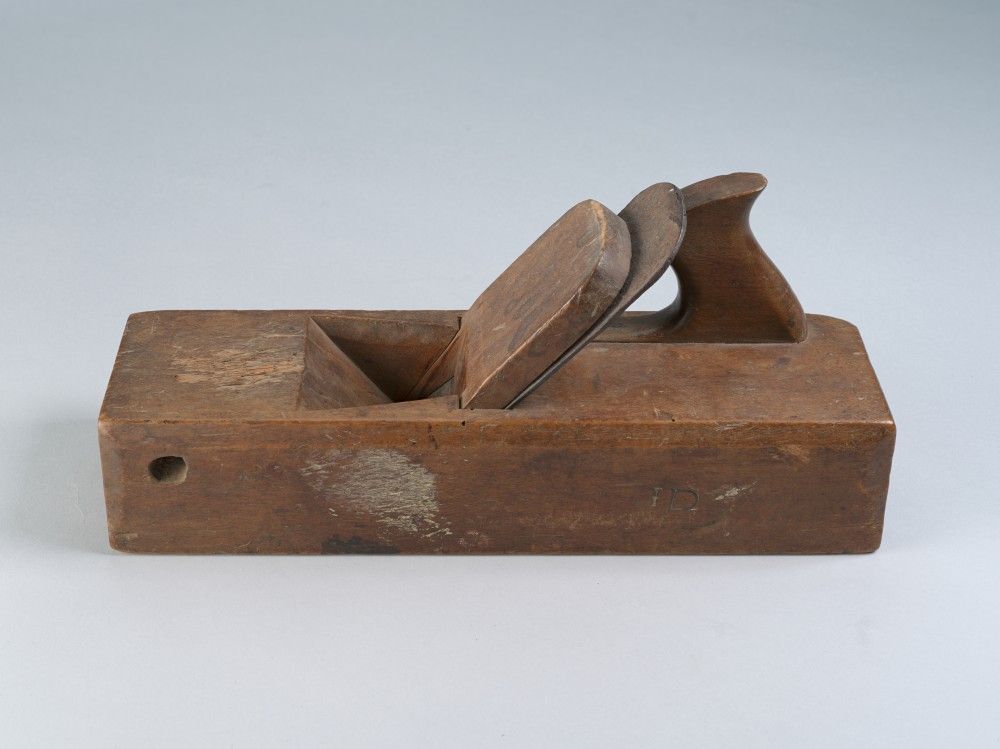
 The woodworking plane is among the oldest and most successful of hand-tool designs. Its principle is straightforward: a sharpened iron blade is held at a controlled angle in a stock that slides over a wooden surface. By adjusting the depth of the cutting edge, the craftsman can remove anything from heavy shavings to an almost transparent curl of wood.
Planes were known in the Roman world, and surviving examples demonstrate that the essential principle was established nearly two thousand years ago. By the 17th century, wooden planes of recognizably modern design had become standard equipment in European woodworking shops.
Britain developed an important specialized planemaking industry. By the 18th century, makers produced planes for almost every conceivable woodworking operation, including smoothing boards, joining edges, cutting grooves, forming architectural moldings, and manufacturing window sashes.
The American colonies initially depended heavily upon imported British tools. As colonial furniture making and construction expanded, American craftsmen began producing their own planes, often following familiar British patterns.
By the early 19th century, wooden planemaking was becoming a substantial American industry. Independent makers were joined by larger manufacturers whose products were distributed through hardware merchants and tool dealers.
Firms such as the Sandusky Tool Company, Ohio Tool Company, Auburn Tool Company, and Greenfield Tool Company produced extensive lines of wooden planes. The industrialization of toolmaking brought greater standardization, wider distribution, and generally lower prices.
Wooden planes remained important throughout the 19th century, although improvements in cast-iron plane construction, particularly those associated with Leonard Bailey and Stanley, gradually displaced many traditional forms. Specialized wooden planes nevertheless remained useful well into the 20th century.
The principal varieties of wooden planes
The enormous variety of surviving planes can make identification intimidating. Fortunately, most examples belong to a relatively small number of functional families.
Bench planes
Jack, fore, jointer, and smoothing planes were used to flatten and finish boards. A jointer might measure two feet or more, while a smoothing plane could be less than eight inches long. The short, rounded coffin smoother is particularly recognizable.
Molding planes
These tools cut decorative profiles into wood. Common examples include beads, coves, ogees, hollows, and rounds. They were indispensable in manufacturing furniture moldings, cornices, doors, and interior trim.
Plow planes
Plow planes cut grooves parallel to the edge of a board. Many have adjustable fences, wooden screws, and interchangeable cutting irons. Elaborate examples made of rosewood, boxwood, ebony, or other fine woods are among the most desirable collectible planes.
Tongue-and-groove planes
Often produced as complementary pairs, these planes cut the mating tongues and grooves used to join boards. Matched pairs bearing the same maker's stamp and retaining their original irons can attract a premium.
Special-purpose planes
Rabbet, sash, fillister, dado, panel-raising, and other specialized planes performed particular joinery operations. Some unusual patented or regional patterns are substantially scarcer than ordinary molding planes.
The enormous range of molding-plane profiles deserves particular attention. Before powered molding machines became widespread, architectural details that could be produced rapidly by machinery required considerable manual labor. A cabinetmaker or joiner might own dozens of planes, each intended to produce a particular molding or part of a more complicated profile.
Early American makers: Francis Nicholson and Cesar Chelor
Among the most historically important American planemakers were Francis Nicholson (1683–1753) and Cesar Chelor (died 1784), both associated with Wrentham, Massachusetts.
Nicholson is widely recognized as the earliest documented professional planemaker in colonial America. His surviving tools are important artifacts of American craftsmanship before the Revolution.
Cesar Chelor's history is particularly remarkable. Born into slavery, Chelor learned planemaking while enslaved by Nicholson. He was emancipated through Nicholson's estate arrangements and subsequently worked as an independent planemaker.
Chelor is recognized as one of the earliest documented African American toolmakers. Surviving planes bearing his stamp provide tangible evidence of his professional work and of African American participation in skilled colonial manufacturing.
The historical importance of these tools is reflected in museum collections. Colonial Williamsburg has exhibited a Nicholson-Chelor collection, while the Smithsonian's National Museum of African American History and Culture preserves multiple examples of their workmanship.
Planes by Nicholson and Chelor are not merely antique woodworking tools. They are surviving products of identifiable colonial craftsmen whose biographies form part of early American industrial history.
Their values can be extraordinary compared with those of ordinary 19th-century examples. Even relatively unremarkable molding profiles may be highly collectible when the maker's attribution is firmly established.
The great 19th-century American manufacturers
By the middle of the 19th century, several manufacturers were producing wooden planes on a much larger scale.
Sandusky Tool Company, Sandusky, Ohio. Sandusky is particularly well known among collectors for its elaborate plow planes. The company produced a broad range of tools, from ordinary bench and molding planes to highly finished examples incorporating exotic hardwoods and intricate adjustment mechanisms.
Ohio Tool Company, Columbus, Ohio. One of the important American plane manufacturers, Ohio Tool produced bench planes, molding planes, and highly collectible specialty and plow planes. Its product numbers and maker stamps are valuable identification aids.
Auburn Tool Company, Auburn, New York. Auburn was a major source of ordinary working planes, including molding planes produced in considerable variety. These are frequently encountered today.
Greenfield Tool Company, Greenfield, Massachusetts. Greenfield manufactured a substantial range of wooden planes, with examples surviving in many of the common bench and specialized forms.
The names of these manufacturers are worth knowing, but a maker's mark alone does not guarantee great value. An ordinary Sandusky molding plane and a rare Sandusky presentation plow plane occupy entirely different levels of the collecting market.
What makes a wooden plane valuable?
As with many antiques, age alone is an unreliable indication of value. A common molding plane manufactured in 1880 may sell for less than a modern reproduction, while an uncommon plane made a century earlier can be worth several thousand dollars.
The principal considerations are maker, rarity, form, condition, completeness, and provenance.
Maker and identification. Many wooden planes carry a maker's name stamped into the toe, the front end of the stock. Some also have trade names, model numbers, or identifying marks on the cutting iron. A clear, uncommon maker's stamp can be the single most important factor in identifying a valuable plane.
Rarity and form. Ordinary straight molding planes were manufactured in large quantities. Unusual patented designs, complex molding profiles, presentation pieces, and rare specialist planes are considerably more desirable.
Materials and workmanship. Most ordinary planes were manufactured from beech or other durable hardwoods. More elaborate examples incorporated rosewood, ebony, boxwood, brass, and sometimes ivory. However, exotic wood alone does not establish rarity.
Originality and completeness. A valuable plow plane may originally have been supplied with multiple cutting irons, fences, depth stops, screws, and other accessories. Missing components can substantially diminish its value.
Condition. Original finish, crisp maker's marks, intact surfaces, and undamaged working components are desirable. Cracks, broken wedges, excessively worn soles, and heavily corroded irons detract from value. Aggressive refinishing or sanding can be particularly destructive because it removes original surfaces and may weaken identifying marks.
Historical associations. Planes belonging to documented craftsmen or associated with historically important workshops may carry additional value. An owner's stamp is not necessarily a maker's mark, but an identifiable original owner can sometimes contribute meaningful provenance.
What are antique wooden planes worth?
The market ranges from inexpensive lots of ordinary working tools to rare examples sold through specialist auctions.
The following figures illustrate broad American market expectations, not fixed appraisals.
Type of wooden plane | Indicative value |
|---|---|
Common 19th-century molding plane | $10–$40 |
Good-quality uncommon molding plane | $40–$150 |
Common wooden bench or jointer plane | $25–$100 |
Complete ordinary plow plane | $100–$350 |
Fine hardwood plow plane, desirable maker | $350–$1,500+ |
Rare colonial American plane | $500–$5,000+ |
Exceptional presentation or unique plane | Several thousand to six figures |
Estimated ranges for collector retail or individual sales in 2026. Actual auction prices can be lower, particularly for common planes sold in groups.
Documented sales illustrate the difference
23 wooden planes — $246
At Jeffrey S. Evans & Associates on August 26, 2023, a group of 23 19th-century wooden planes, including molding and tongue-and-groove examples, sold for $246 including buyer's premium. That works out to approximately $10.70 per plane.
Francis Nicholson molding plane — $3,616
An 18th-century ogee-and-astragal molding plane bearing Nicholson's distinctive Wrentham mark brought $3,616 at Brown's 51st International Antique Tool Auction, reported in 2017. Its historical importance and maker attribution transformed an otherwise ordinary-looking tool into a valuable collectible.
A rosewood example was recorded at $3,995 in specialist dealer sales data for September 2026. This illustrates the premium that a desirable model, fine materials, and exceptional presentation can command.
A wooden plane that sold for $114,400
One of the most remarkable results in antique tool collecting occurred at Brown's 25th International Tool Auction, reported in January 2005.
An extraordinary Sandusky Tool Company self-adjusting center-wheel plow plane sold for $114,400. The plane was constructed with an ebony body, ivory arms, and nickel-plated fittings.
Described as a unique example, it combined elaborate construction, superior materials, rarity, and the reputation of one of America's foremost plane manufacturers.
The result was exceptional even within the specialist collecting market. Another important plow plane, patented by Israel White in 1834, sold at the same auction for $17,600.
These results should not be mistaken for typical values. Rather, they demonstrate the extent to which collectors distinguish between ordinary working tools and exceptional artifacts of American toolmaking.
Identifying a potentially valuable wooden plane
For someone who discovers an old wooden plane at an estate sale, antique shop, or inherited workshop, a few basic observations can establish whether further research is warranted.
First, examine the toe for a maker's stamp. Look under good directional lighting, but avoid sanding or otherwise cleaning the surface aggressively. Some important marks are faint and easily destroyed.
Next, identify the function of the plane. Examine its sole, the shape of its cutting iron, and any adjustable mechanisms. A simple bead plane is generally less unusual than a complex plow plane with multiple adjustments.
Check the iron and wedge for completeness and appropriate fit. A blade that does not match the sole's profile may be a later replacement.
Finally, inspect the wood itself. Wear caused by generations of use is often acceptable, but broken or replaced components and excessive restoration should be considered carefully.
Most importantly, do not assume that an owner's initials represent the manufacturer's name. Numerous craftsmen stamped their tools to identify personal property. Differentiating a maker's mark from an owner's stamp may require comparison with published references.
Should old wooden planes be restored?
Collectors and woodworkers do not always agree about restoration.
A craftsman purchasing an antique plane for use may reasonably wish to sharpen the iron, flatten the sole, and make the tool fully functional. A collector of historically important tools is more likely to prize original surfaces and construction.
For an ordinary working plane, modest restoration may improve its usefulness and marketability. For a rare 18th-century example, the same alterations could seriously diminish its historical integrity and financial value.
Cleaning with a soft brush and preserving the existing surface is generally a safer initial approach than sanding, stripping, varnishing, or polishing.
A surviving record of craftsmanship
Wooden planes are tangible reminders of an era when architectural ornament and much of the finest furniture were created by hand.
A cabinetmaker producing a finely molded cornice or a complex piece of joinery required not only skill but also an assortment of specialized tools. Many of those tools survive, often with the marks of their original makers and owners.
Collectors therefore encounter two distinct markets. The first consists of plentiful, modestly priced 19th-century planes purchased for decoration, historical interest, or continued woodworking use. The second centers on the rarer products of important craftsmen, innovative manufacturers, and exceptional toolmakers.
The distinction is substantial. An ordinary wooden molding plane may be worth little more than the cost of shipping it, while an apparently similar example bearing the stamp of a significant colonial maker may be worth thousands.
For anyone examining an old tool chest, the lesson is straightforward: before dismissing a wooden plane as an obsolete carpenter's tool, examine its maker's mark, construction, and design.
References and further reading
Woodworking Tools, 1600–1900, United States National Museum Bulletin 241, Smithsonian Institution. A particularly valuable historical survey, with period illustrations and technical descriptions. Read the digitized publication
Emil and Martyl Pollak, A Guide to the Makers of American Wooden Planes. An important reference for maker identification and historical attribution. Historic New England catalog record
Colonial Williamsburg, Nicholson-Chelor Plane Collection. Important museum documentation concerning early American planemakers. View the collection
Lee Valley Tools, Collecting Molding Planes. A practical introduction to traditional molding planes. Read the guide
Antique Tools in Pennsylvania Forge a $513,884 Gross, Antiques and the Arts Weekly, January 4, 2005. Documents the extraordinary Sandusky sale. Read the auction report
Early American Industries Association, Brown's 51st International Antique Tool Auction. Includes documented auction prices for Nicholson and other early planes. Read the auction review