
Currier & Ives did not merely illustrate Central Park; the firm helped fix the new park in the American visual imagination. These lithographs belong to the moment when Central Park was still a public works experiment becoming a social fact. In the early 1860s, New Yorkers were learning how to use the park - skating on its new water bodies, driving its carriage roads, strolling its promenades, and reading its rustic bridges and picturesque lakes as proof that the city could manufacture repose. Currier & Ives recognized that this was not just scenery. It was news, aspiration, civic branding, and a saleable image of metropolitan refinement.
For that reason, Central Park prints form a genuine collecting zone within the Currier & Ives catalogue. The group is small enough to be intelligible yet rich enough to reward specialization. It cuts across several categories at once: New York iconography, landscape architecture, urban history, winter sports imagery, and the firm's own internal hierarchy of folio sizes. A collector can pursue the park as a miniature sub-catalogue rather than as a random scattering of city views.
The First Central Park Series
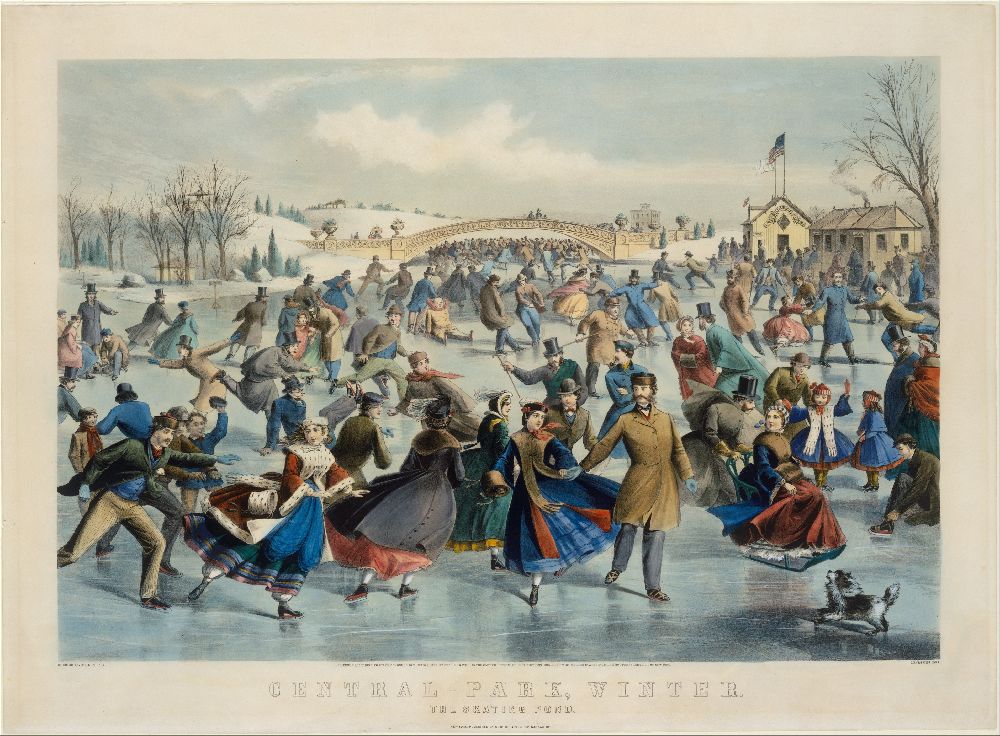
The strict first wave belongs to the early 1860s, when the park had begun to open to public use and when Currier & Ives was still responding to the novelty of specific park features. The anchor sheet is Central-Park, Winter. The Skating Pond, published in 1862 after Charles Parsons. Around it cluster views of the drive, the lake, and bridge subjects that translate the new park into a repertory of recognizable destinations.
| Title | Date | Folio Size | Comment |
|---|---|---|---|
| Central-Park, Winter. The Skating Pond | 1862 | Large folio | The prestige sheet of the group and the likeliest market leader among Central Park subjects. |
| Central Park, The Drive | 1862 | Medium folio | An early carriage-drive view that records the park as a place of motion, display, and social ritual. |
| Central Park, The Lake | 1862 | Medium folio | A summer counterpart to the winter skating imagery and one of the key lake views. |
| Central Park - The Bridge | catalogued undated; museum example 1862-71 | Small folio | A Bow Bridge subject in compact format, attractive to collectors who want a named park structure without large-folio pricing. |
| Rustic Bridge, Central Park, New York | catalogued undated; early 1860s issue | Small folio | A particularly appealing composition because the reflected bridge doubles the image's visual architecture. |
| Central Park, Winter. The Skating Carnival | catalogued undated; early 1860s issue | Small folio | More social and anecdotal than The Skating Pond, but part of the same winter-imagery cluster. |
If one is building the core set, these are the essential titles. They make sense together, they belong to the formative years of the park, and they show Currier & Ives testing different scales of issue: the large folio for spectacle, the medium folio for substantial but manageable city views, and the small folio for more affordable, more frequently encountered park subjects.
Later Park Subjects and Prints in Which Central Park Is an Element
Currier & Ives did not stop with the first wave. Later sheets either returned to named park subjects or folded Central Park into a broader visualization of New York.
| Title | Date | Folio Size | How Central Park Functions |
|---|---|---|---|
| Central Park in Winter | later issue; Met dates one example 1868-94 | Small folio | A later, more generalized winter subject that keeps the park in the firm's saleable repertory. |
| Bethesda Fountain - Central Park, New York | 1868-78 | Small folio | A landmark print centered on one of the park's great formal set pieces after the fountain had become an established icon. |
| Fashionable "Turn-Outs" in Central Park | 1869 | Large folio | Not just topography but social performance: the park as carriage theater. |
| New York and Brooklyn | 1875 | Large folio | Central Park appears as part of the metropolis's legible plan and green interval. |
| The City of New York | 1876 | Large folio | The park functions as a panoramic landmark rather than the single subject, which matters to collectors of city views. |
This second group matters because it shows how the meaning of Central Park changed. In the first wave, the park is new and particular. In the later material, it is established, socially coded, and increasingly inseparable from the idea of New York itself.
Why the Folio Size Matters
In Currier & Ives collecting, size is not a trivial production detail. It often tracks ambition, subject weight, and price structure. Large folios tend to command the highest attention because they deliver spectacle, survive in smaller numbers in strong condition, and were expensive enough at the outset to imply a more serious purchase. The medium folios occupy an excellent middle register: substantial enough to feel important, but often more attainable. Small folios are not minor in interest, only in scale; in specialized areas such as Central Park they can be the backbone of a serious collection.
That distinction matters in practice. A collector who cannot justify the leap to The Skating Pond can still assemble a meaningful Central Park group through the medium-folio Drive and Lake together with the small-folio bridge and winter sheets. In other words, the specialty is scalable. One can pursue the park as a major curatorial theme without insisting on the most expensive large folios at the outset.
Central Park Development: Key Milestones to 1907
The prints are much easier to read when placed against the actual development of the park.
| Year | Milestone | Why It Matters for the Prints |
|---|---|---|
| 1853 | State officials approved funds to acquire the land for the park. | The project became politically real before it became visually legible. |
| 1857-1858 | The design competition was held and Olmsted and Vaux's Greensward plan won in 1858. | This is the conceptual foundation for every park view Currier & Ives later marketed. |
| 1858 | Construction began; by December the new skating pond had already triggered an ice-skating craze. | The winter sheets are not fanciful inventions. They answer a documented public enthusiasm. |
| 1859 | The Ramble opened. | By this point enough of the park existed for recognizable subject matter. |
| 1858-1862 | The Reservoir was constructed. | Major water engineering and landscape fabrication underwrote the new park imagery. |
| 1862 | Bow Bridge was completed; the firm issued The Drive, The Lake, and The Skating Pond. | The print series and the park's physical completion of key features move in tandem. |
| 1864 | Sheep were introduced to what became Sheep Meadow. | The park's pastoral rhetoric was not merely symbolic; it was staged in lived form. |
| 1865-1872 | Work resumed under renewed Olmsted-Vaux involvement; later structures including Belvedere-era and Children's District features advanced. | The park shifted from novelty to maturity, broadening the repertory for later prints. |
| 1871 | The Dairy was completed. | By the early 1870s the park had acquired social infrastructure, not just scenery. |
| 1873 | Bethesda Fountain and the Angel of the Waters became established as one of the park's defining landmarks. | This helps explain why a distinct Bethesda print belongs to the later phase rather than the first wave. |
| 1875-1876 | Large New York panoramas treated Central Park as a fixed landmark within the metropolis. | The park was no longer merely a destination inside the city; it had become one of the city's identifiers. |
| 1907 | Currier & Ives ceased operations. | By the end of the firm, Central Park was no longer an experiment but an established civic classic, and the early sheets had already become documents of origin. |
Condition, Margins, and Color: What Serious Collectors Actually Want
Serious collectors want the obvious things, but the obvious things are rarely found together. Full margins matter because Currier & Ives sheets were often trimmed for framing. Fresh hand color matters because these prints were made to be lively, not dull. Clean paper matters because toning, foxing, mat burn, repairs, and pasted mounts are common. Yet the market repeatedly forces compromise. Many of the most attractive Central Park subjects survive with some combination of margin reduction, old backing, light restoration, or uneven color retention.
The practical result is that collectors often buy on hierarchy rather than perfection. Subject first, then freshness of impression, then margins, then color, then restoration profile. That order is not universal, but it reflects the reality that one may wait a very long time for an ideal example of a desirable park subject, and when it appears the price may move far beyond the comfort zone of even knowledgeable buyers.
There is also a useful distinction between damage that disqualifies and damage that merely discounts. Heavy repainting into the image, severe trimming into the title or publisher's line, and major tears that disrupt the composition push a print into caution territory. By contrast, modest marginal wear, old mounting, or a skillfully handled repair may simply place a desirable sheet into a more attainable bracket. This is especially true in Central Park material, where scarcity of really handsome examples means the collector often buys the best intersection of image quality, completeness, and price rather than an impossible ideal.
Value and Market Hierarchy
If one had to nominate the strongest market title in the Central Park group, Central-Park, Winter. The Skating Pond is the best candidate. It has the scale advantage of the large folio, it is tied to Charles Parsons, it sits high in the traditional hierarchy of Currier & Ives large folios, and it condenses several collecting constituencies into one object: winter sports, New York history, and iconic nineteenth-century American printmaking.
Evidence points in the same direction even when the sources measure different parts of the market. The American Historical Print Collectors Society places The Skating Pond third in the original "Best Fifty" large folios. Freeman's carried an example with a published estimate of $7,000 to $9,000, even though that sheet was described as trimmed and with condition issues. At the high retail end, The Old Print Shop currently asks $25,000 for an example. These figures are not interchangeable - club ranking, auction estimate, auction result, and dealer asking price are different kinds of evidence - but taken together they support the view that The Skating Pond stands at or very near the top of the Central Park subset.
By comparison, the medium-folio and small-folio sheets usually occupy a lower but still respectable range. They are often the more rational entry point for collectors who care about the subject deeply but do not want to chase a marquee large folio immediately. In that sense, the Central Park specialty is unusually healthy: it has a flagship print at the top, but it also has a serious middle market.
Why This Specialty Holds Together
Some Currier & Ives collecting niches feel artificial, as though they were built after the fact by dealer convenience. Central Park is not one of them. The group holds because the subject is intrinsically coherent. The prints correspond to a real public project, a finite geography, a known developmental arc, and a recognizably New York set of motifs. They also reward connoisseurship. One can learn address lines, date ranges, folio logic, later versus earlier issues, and the difference between a park-specific sheet and a panoramic city view in which the park is a structural element.
That combination of coherence and nuance is exactly what turns an attractive subject into a durable collecting field. Central Park prints are decorative, yes, but the better reason to take them seriously is that they document the making of an American civic ideal. In the best examples, Currier & Ives did not just reproduce a place. They recorded the moment when New York learned to see nature as something the modern city could design, possess, and publicly perform.
References
The Metropolitan Museum of Art, Central Park, Winter - The Skating Pond
The Metropolitan Museum of Art, Central Park - The Drive
The Metropolitan Museum of Art, Central Park - The Lake
The Metropolitan Museum of Art, Central Park - The Bridge
The Metropolitan Museum of Art, Central Park in Winter
The Metropolitan Museum of Art, Bethesda Fountain - Central Park, New York
The New York Public Library, Central-Park, winter. The skating pond. New York
American Art Association catalog, Currier and Ives and Other Rare American Lithographs
Central Park Conservancy, 160 Years of Central Park: A Brief History
Central Park Conservancy, Park History
Central Park Conservancy, The Competition: 33 Plans for Central Park in 1858
Library of Congress, Central Park, Civil War, and California, 1857-1865
Central Park Conservancy, Reservoir
Central Park Conservancy, Dairy Visitor Center
NYC Parks, Sheep Meadow
American Historical Print Collectors Society, The Currier & Ives Best Fifty
Invaluable / Freeman's, Central-Park, Winter. The Skating Pond
The Old Print Shop, Charles Parsons / New York material
The Old Print Shop, Fashionable "Turn-Outs" in Central Park
The Old Print Shop, New York and Brooklyn
The Old Print Shop, The City of New York
