
The history of the American cast-iron toy industry is usually told through a familiar group of names: Hubley, Arcade, Kenton, A. C. Williams and J. & E. Stevens. Dent Hardware Company belongs in that company, yet its history is somewhat different.
Dent did not begin primarily as a toy manufacturer.
It was an industrial hardware company with foundries, machinery, engineers and a substantial business supplying the rapidly developing refrigeration industry. Toys emerged from that manufacturing environment and eventually became significant enough that the National Museum of Industrial History describes Dent as one of the nation's foremost producers of cast-iron toys. The company was established by Henry H. Dent and associates in 1894, and its cast-iron toy production extended approximately from 1898 to 1937.
That dual identity—industrial hardware manufacturer and toy maker—is essential to understanding Dent.
Its toys were not an isolated sideline created in a small workshop. They came from an organization accustomed to pattern making, foundry work, machining, finishing and the production of durable metal objects. Dent's toys were, in a sense, another expression of the same industrial culture that produced its refrigerator hinges and latches.
And because so much original documentation survives, Dent offers something even better for modern collectors: we can often compare the toys themselves with the products the factory was actually advertising more than a century ago.
A factory large enough to show up on the map
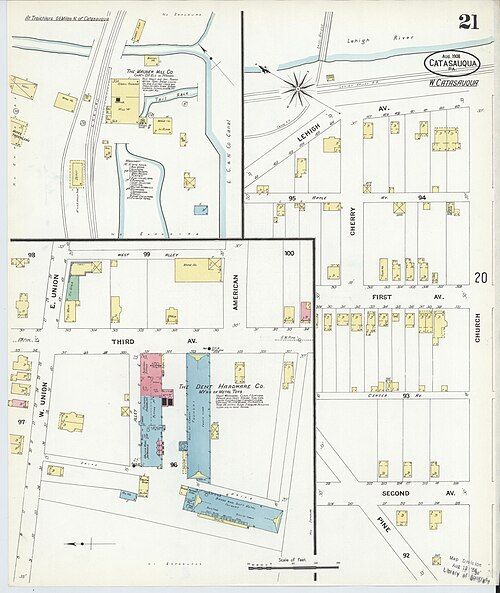 One of the strongest pieces of primary evidence for Dent is not a toy at all.
The Library of Congress holds the August 1908 Sanborn Fire Insurance Map for Catasauqua and neighboring communities, including Fullerton. The series consists of 28 sheets and documents the industrial landscape in which Dent was operating at the height of its early toy production. The Library of Congress identifies the material as public domain and free to reuse.
On the Fullerton sheet, the Dent Hardware works occupies a substantial industrial complex.
That matters.
Dent was not merely casting a few toys in the back of a hardware shop. By the first decade of the twentieth century it possessed the physical infrastructure of a significant manufacturing concern.
The surviving factory complex, built principally between 1894 and 1913, later entered the National Register of Historic Places. Historical documentation describes Dent as the nation's leading producer of brass refrigerator hardware and one of Pennsylvania's two largest producers of cast-iron toys.
The toys therefore emerged from a company already possessing industrial scale.
The remarkable early toy catalog
Perhaps the most important Dent source to survive is a modest 39-page trade catalog.
Southern Methodist University's DeGolyer Library records:
The Dent Hardware Co., Iron Toys, Fullerton, Pennsylvania, circa 1900–1910, 39 pages.
A surviving copy identifies the Allentown printer as Berkemeyer, Keck & Co. Its pages reveal an extraordinarily broad line of cast-iron transportation toys.
The catalog is historically important because it captures the transportation world of America at the beginning of the twentieth century.
There are horse-drawn carts, pony carts, coal carts and wagons. There are fire vehicles, carriages and automobiles. Other surviving descriptions of the catalog mention locomotives, trains, steamboats and battleships.
It is almost possible to watch modernization occur page by page.
That may be Dent's most interesting contribution to toy history: its catalog became a miniature representation of the changing American streetscape.
From horses to horsepower
The Smithsonian has used precisely this idea when discussing early cast-iron toys.
The National Museum of American History owns a horse-drawn cast-iron steam fire pumper, dating to about 1900 and possibly manufactured by Dent between approximately 1905 and 1910. The Smithsonian notes that cast-iron toys document the transition from equine transportation to mechanized vehicles: horse-drawn equipment disappears while trucks and tractors take its place.
Dent provides an unusually good case study.
Around 1910, a child might receive an elaborate horse-drawn ice wagon or fire apparatus.
By the 1920s and 1930s, the same company was offering automobiles, buses, airplanes and dirigibles.
A later Dent Toys Catalogue No. 10, published in 1925, announced not only cast-iron toys but also cast-aluminum toys, repeating and single-shot pistols and jacks.
Its introductory page characterized the iron line as modern, up-to-date reproductions assembled and finished in bright colors. The aluminum toys were promoted as lighter and almost indestructible.
The company was clearly adapting.
One delightful page advertises “Toylands Treasure Chest,” a boxed assortment containing a Zeppelin, an overland bus, a sedan and a speed wagon.
That assortment says almost everything about the evolution of Dent.
The horse cart had become the motorcar. The carriage had become the bus. And the sky itself had become a playground.
Dent and the airplane age
Dent's aircraft deserve particular attention from collectors.
By the mid-1930s Kilgore was already combining old and new materials in the same toy. Contemporary trade advertising described some of its repeating cap pistols as having Bakelite cases with cast-iron mechanisms, a revealing transitional construction that paired a modern molded exterior with traditional metal working parts. Kilgore's later “Jewels for Playthings” vehicles represented a further step, using injection-molded cellulose acetate to create lightweight toy cars and trucks rather than simply adding plastic components to metal toys.
The Lucky Boy is especially interesting.
Auction documentation records that the model apparently would have been called “Lindy,” presumably referring to Charles Lindbergh, but that Dent was unable to obtain the necessary licensing rights. The company therefore marketed it under another name.
That small detail brings us remarkably close to the commercial realities of the 1930s toy business. Even then, recognizable celebrities and famous machines had commercial value—and manufacturers had to think about permission to use those associations.
Dent also produced one of the most visually memorable toys of the Art Deco period: a large cast-iron Zeppelin.
A 1992 exhibition of Art Deco playthings identified a Dent Zeppelin produced around 1930 and modeled on the Los Angeles, the famous American rigid airship of the period.
For a collector, these aircraft represent the point at which Dent's catalog moved decisively from Victorian and Edwardian transportation into the Machine Age.
Fire apparatus: where Dent reached its spectacular best
If one category defines the most ambitious early Dent toys, it may be fire apparatus.
The company produced hose reels, water towers, steam pumpers and enormous hook-and-ladder combinations pulled by teams of cast-iron horses.
These were not small penny toys.
Some were more than two feet long.
A published collection of important American cast-iron toys documents extraordinary circa-1910 Dent examples including a 33-inch water tower, a 24-inch hose reel and a 32-inch electroplated hook-and-ladder. The same source recounts how pioneering collectors Gertrude and Covert Hegarty discovered nearly 300 unsold Dent toys from the early 1910s in old store stock, helping preserve unusually pristine examples for later collectors.
Those large fire toys represent Dent at its most theatrical.
Multiple horses, drivers, ladders, hose reels, water towers and painted decoration combined to create toys whose physical presence approaches that of folk sculpture.
Today, they are among the Dent pieces most likely to anchor an advanced collection.
The ice wagon: a snapshot of everyday America
At the opposite end of the spectrum lies a humbler but equally revealing toy: the ice wagon.
Dent's circa-1910 No. 98 Ice Wagon was about ten inches long and featured a horse, decorated wagon body and prominent “ICE” lettering. A surviving example has been matched directly to Dent's period catalog.
That ability to match a toy with the manufacturer's original catalog entry substantially increases its historical interest.
The ice wagon also records something children once saw every day but which modern children seldom recognize: household ice delivery before widespread electric refrigeration.
There is an irony here.
Dent manufactured toys depicting the ice-delivery economy while its other factories were making hardware for the refrigeration industry that would eventually help transform that economy.
The company was simultaneously producing miniature images of an older technology and components for the technology replacing it.
Battleships: Dent at monumental scale
One of the most impressive documented Dent toys is the Battleship New York.
An example appeared on Antiques Roadshow. The appraiser identified it as a cast-iron Dent floor toy from approximately 1920, modeled after an actual battleship. The toy is unusually large and extremely heavy—very much a floor toy rather than something meant to float.
When originally appraised in 2009, that particular example received a retail estimate of $4,000–$5,000. That historical appraisal should not be treated as a current market value, but it demonstrates the collecting stature such large Dent pieces had already achieved.
Large ships have several qualities collectors tend to prize simultaneously: scale, visual impact, rarity, historical subject matter and unmistakable manufacturing complexity.
Dent's patents tell a different—but essential—story
One caution is important.
The strongest patent evidence I have found for Dent concerns its industrial hardware, not its toys.
That distinction should be retained rather than implying that Dent patented every famous toy design.
In 1925 Thomas O. Schrader received U.S. Patent No. 1,567,866, a lever lock for refrigerator doors, assigned to Dent Hardware Company.
Dent was also associated with related latch patents including U.S. Patent No. 1,575,647, issued in 1926 for a lock device for refrigerator doors. That patent would become historically significant because it entered a major patent dispute.
Additional Dent-assigned patents covered cooler-door controls, reversible stop fasteners, spring-controlled latches and later closure mechanisms.
This body of intellectual property reveals a company investing in engineering rather than merely producing generic hardware.
Dent goes to the Supreme Court
Dent's industrial importance becomes especially clear in 1929, when a dispute over refrigerator-latch patents reached the United States Supreme Court.
In Sanitary Refrigerator Co. v. Winters and the related Winters v. Dent Hardware Co., the Court considered whether refrigerator latches made by Dent infringed another patented design. Dent had manufactured the disputed latches and had even financed the defense of one of its customers in the litigation.
The Court specifically discussed the Dent latch produced under Schrader's Patent No. 1,575,647.
That episode is useful for understanding the company.
Dent was not merely casting toy horses during the day and hinges at night. It operated in a technically competitive industrial field in which patents, engineering distinctions and commercial rights were important enough to reach the highest court in the country.
Its toy-making expertise existed within that engineering environment.
Was Dent in a rivalry with Hubley, Arcade or A. C. Williams?
This is one area where the evidence requires restraint.
I have found abundant evidence that Dent operated in the same competitive market as Hubley, Arcade, Kenton and A. C. Williams, but I have not found reliable primary evidence of a named corporate feud or deliberate Dent-versus-Hubley rivalry.
That distinction matters.
Collectors often describe the major cast-iron firms as rivals because they competed for the same customers and frequently produced similar subjects. But competition is not the same thing as a documented rivalry.
The overlap is obvious.
Dent offered fire apparatus, horse-drawn wagons, automobiles, airplanes, banks and pistols.
Hubley produced horse-drawn vehicles, tractors, fire equipment, guns and automobiles.
Arcade became famous for detailed transportation and farm toys.
A. C. Williams competed strongly in automobiles, airplanes, trucks and banks.
Kenton produced fire apparatus, wagons, banks and other cast-iron subjects. The Antique Toy Collectors of America places Dent among the American makers specializing in cast-iron and aluminum transportation toys and banks.
There was therefore intense product-category competition.
A child looking at a department-store toy counter might reasonably have encountered several manufacturers offering versions of the same real-world object.
Arcade and Hubley appear to have had the clearest direct rivalry
Of the major makers, sources most often characterize Hubley and Arcade as direct competitors. Contemporary collector histories specifically identify Arcade as Hubley's principal early competitor.
Dent appears instead to have occupied somewhat different ground.
Its most elaborate early toys—especially enormous horse-drawn fire equipment—could be unusually ambitious, while the company's broader industrial operation meant toy manufacture never constituted its sole identity.
Kenton's history shows how fierce the industry could be
Kenton provides another illuminating comparison.
Its toy business developed partly after disputes connected with refrigerator-lock patents. It later participated in unsuccessful toy-company combinations or “trusts,” during which patterns moved among manufacturers including J. & E. Stevens, Grey Iron Casting and Jones & Bixler. That explains why some cast-iron toys appear under more than one maker.
I have found no evidence that Dent joined those toy trusts.
That may actually be historically significant. Dent seems to have remained more vertically grounded in its own hardware-and-foundry operation while competing in the broader toy market.
Ironically, Arcade and Dent competed in hardware too
There is one intriguing point where the toy world and industrial hardware world intersect.
Patent literature from the era shows Arcade Manufacturing Company, another famous cast-iron toy maker, appearing in latch technology as well. One later patent's cited prior art includes a 1931 Arcade Manufacturing Co. latch patent, while other citations include Dent latch designs.
That does not establish a personal feud between Arcade and Dent.
But it illustrates how similar these companies could be structurally. They were not simply “toy companies.” Their foundries made useful metal goods, machinery components and hardware alongside playthings.
The same industrial skills fed both businesses.
What should a Dent collector look for?
For a serious collection, certain Dent categories stand above routine examples.
The most desirable pieces generally combine size, complexity, original paint, completeness and documented catalog identification. Among the major targets are:
- Large horse-drawn fire apparatus, particularly multi-horse hook-and-ladder trucks, hose reels and water towers. These represent the technical and decorative peak of Dent's early production.
- Battleships and large ships, especially substantial floor toys such as the Battleship New York.
- Early horse-drawn commercial vehicles, including ice wagons, coal carts and delivery wagons that can be matched to the circa-1910 catalog.
- Aircraft, especially larger Air Express, Lucky Boy and Ford Tri-Motor forms. Original wheels, paint and factory tags matter greatly.
- The Zeppelin, particularly the large streamlined examples associated with the Los Angeles.
- Unusual cataloged sets, such as the Toylands Treasure Chest with multiple transportation toys.
- Original-condition toys with strong provenance, particularly examples tied to old collections, factory families or original dealer stock.
Condition deserves special emphasis.
Cast-iron toys were meant to be played with. Horses lost legs. Drivers disappeared. Ladders vanished. Wheels were replaced. Paint wore away.
As a result, a complete large Dent toy retaining substantial original paint may be far more desirable than an apparently prettier example that has been heavily restored.
Collectors should also be alert to later castings. Auction descriptions of some Dent airplanes explicitly warn that attractive examples may be second castings rather than original-period production.
Catalog comparison is therefore invaluable.
Why the catalogs matter so much
Dent happens to be unusually fortunate in the survival of its literature.
The circa-1900–1910 Iron Toys catalog gives us an early baseline.
The 1925 Catalogue No. 10 shows a later company embracing cast aluminum, motor vehicles, aircraft and toy pistols.
Put those catalogs beside one another and the transformation is striking.
The early world is populated by horses.
The later world is populated by machines.
That makes Dent more than a manufacturer worth collecting. Its products become evidence of changing American ideas about technology, mobility and childhood.
A toy company that was never merely a toy company
Dent's greatest historical distinction may be that its toy line cannot be separated completely from its industrial identity.
The company manufactured refrigerator hardware at a scale substantial enough to support a large factory complex.
It developed patented mechanisms.
It fought a patent case that reached the United States Supreme Court.
And using the same industrial skills, it produced miniature fire engines, wagons, ships, automobiles and airplanes that translated the adult mechanical world into objects children could pull across the floor.
The National Museum of Industrial History still describes Dent as one of the country's important cast-iron toy manufacturers, and descendants of the Dent family have preserved and exhibited examples from the company's history.
Toy production ended around 1937, but the hardware business survived in successor form.
Dent's legacy
Dent Hardware deserves to be remembered alongside the better-known names of American cast-iron toy making.
Hubley may be more immediately familiar to many collectors. Arcade became particularly famous for realistic agricultural and commercial vehicles. A. C. Williams produced enormous quantities of compact cast-iron toys. Kenton possessed a long history in toys and banks.
Dent's particular achievement was different.
It combined the technical resources of a major hardware manufacturer with an extraordinarily imaginative transportation-toy line.
Its products record the transition from the nineteenth-century street to the twentieth-century machine age:
ice wagon to truck, carriage to automobile, horse-drawn fire engine to motor apparatus, and earthbound vehicle to airplane and Zeppelin.
Few manufacturers allow that technological progression to be seen so clearly within a single surviving catalog history.
A Dent toy is therefore more than a heavy piece of painted iron.
It is a miniature industrial artifact from the moment when America itself was changing speed.