
From Mechanical Toys to Railroads
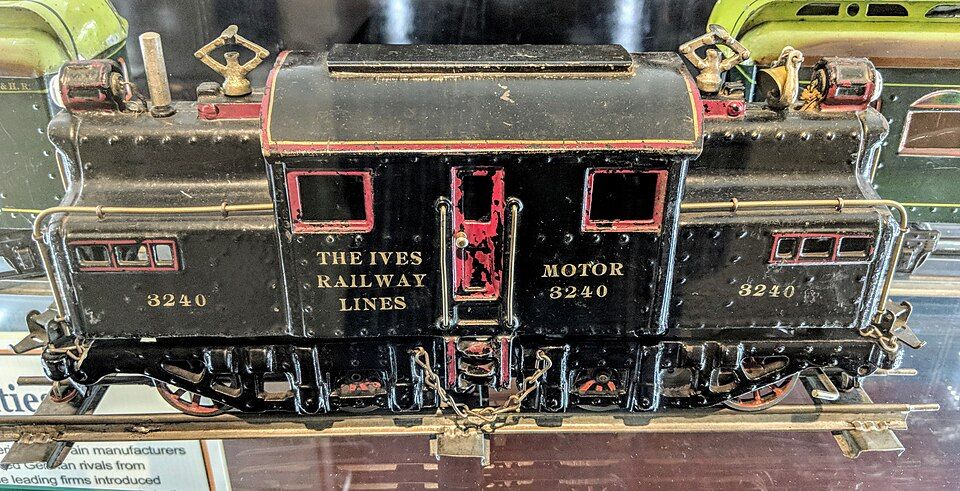
The Ives story did not begin with an electric locomotive. Edward R. Ives established his toy business in Plymouth, Connecticut, in 1868 and developed a varied line of mechanical toys before the company became identified principally with trains. By the late nineteenth century, Ives was already an important American manufacturer of mechanical toys, including moving figures and floor trains.
The event that redirected the company occurred on December 22, 1900. Fire destroyed the Ives factory and, with it, patterns, parts and tooling used in the company's cast-iron toy production. What might have ended the business instead forced Edward Ives and his son Harry to reconsider what Ives would manufacture.
The rebuilding produced a substantially different company. Operating temporarily from rented quarters, Ives introduced a new train system in 1901. These were among the company's first trains intended to operate on fabricated sectional track rather than simply being pushed or wound and allowed to travel across the floor. Production of stamped train parts and track was initially subcontracted to the Bridgeport tool-and-die operation of William Haberlin and Timothy Hays. First-year sales of the new tracked trains were reported at $2,600. [1]
This point is important because histories of early American toy trains sometimes blur two separate developments. The 1901 Ives trains were clockwork trains. They were not electric.
Electric toy railways already existed. Carlisle & Finch had marketed electric trains in the nineteenth century, and Lionel entered the electric railway field around the beginning of the twentieth century. Ives deliberately remained with clockwork propulsion during its first decade of tracked-train production. The company did not introduce its own electric trains until 1910. [1][2]
Thus Ives was not the American inventor of the electric toy train, nor did it precede Lionel in electric trains. Its achievement lay elsewhere.
Building a Railroad Rather Than Selling a Train
The remarkable feature of the early Ives system was its scope.
A locomotive and cars were only the beginning. Ives supplied track, switches, signals, stations, bridges, tunnels and other equipment with which a child could gradually construct a miniature railroad. Contemporary Ives material devoted considerable space to track plans and layouts. The product was becoming a system rather than a single toy.
The distinction mattered commercially. A train could be purchased once; a railroad could be expanded for years.
Ives reinforced the idea through the fictional Ives Railway Lines. A boy did not merely own an Ives train. He could become part of a railroad organization and assume the role of its operator or superintendent. Promotional material eventually included membership cards, pins, tickets and railroad-related equipment.
The concept reached an unusually elaborate form in publications such as How Six Boys Built a Railroad and The Railroad That Six Boys Built. The stories followed boys constructing and operating a miniature railroad, buying additional Ives equipment as their system expanded. Railroad operation was presented as play, engineering exercise, geography lesson and introduction to commerce at the same time. [3]
In one episode the boys assign products to different cities and move freight between them. The sales message was obvious, but so was the educational philosophy: a toy railroad could model the economic geography of the United States.
Harry Candee Ives would later make essentially the same argument in public life. Toys, in his view, were not frivolous objects detached from education. Mechanical toys introduced children to the technological world they would eventually inhabit.
The Holland Avenue Factory
Success allowed Ives to leave its temporary post-fire arrangements behind. In 1907 the company erected a new factory on Holland Avenue in Bridgeport.
The Historic American Engineering Record describes the building as the first factory in the United States constructed specifically for the manufacture of toy trains. [1] It represented the degree to which trains had transformed the old mechanical-toy concern.
Production combined metalworking, painting, lithography, assembly and electrical work. The federal industrial history records an operation that could be surprisingly ingenious. Early electric-motor field and armature winding, for example, reportedly made use of equipment adapted from treadle sewing-machine technology before the process became electrified and expanded. Cars progressed from labor-intensive hand painting and striping toward increasing use of lithographed sheet metal.
The factory itself expanded in 1917, eventually extending toward Mountain Grove Street. At its 1920s peak the company reportedly employed roughly 300 people. [1]
Ives was no longer a small maker of mechanical novelties. It had become a specialized industrial manufacturer.
Electricity Arrives in 1910
Ives finally entered the electric-train market in 1910.
The timing can look surprisingly late from a modern perspective. Lionel and other American manufacturers had already demonstrated electric trains. But household electrification was still incomplete, and a clockwork train required neither household current nor batteries.
When Ives made the transition, however, it did so seriously. The 1910 line included new electric O-gauge equipment alongside modernized passenger and freight trains. Contemporary catalog evidence and surviving specialist research both identify 1910 as the decisive year for Ives electric production. [1][4]
Power could be supplied through batteries or through transformers reducing household current to the lower voltages required by the railway.
Electricity also changed what a toy railroad could do. A wound spring imposed an obvious limit on operating time. Electric propulsion made continuous operation, switching and increasingly sophisticated control practical. It brought the miniature railroad closer to the experience of operating a real transportation system.
The company's success was considerable. The federal HAER study states that Ives became the country's largest producer after introducing electric trains and retained that position until 1919. Other histories extend Ives's national sales leadership to 1924, when Lionel overtook it. [1][5] The disagreement over the precise endpoint should not obscure the larger fact: a company that entered electric trains after several competitors nevertheless became one of the dominant American train makers of the era.
O Gauge, Gauge 1 and Wide Gauge
Ives did not remain tied to a single scale or operating system.
Its early tracked trains included O gauge and larger Gauge 1 equipment. Gauge 1 eventually declined in importance in the American market, and in 1921 Ives moved toward what it called Wide Gauge, comparable to Lionel's Standard Gauge.
The large trains of the 1920s were substantial toys. Bright lithography and painted metal increasingly gave way to more elaborate construction, greater realism and sophisticated electrical features. Locomotives became larger and more imposing, while accessories allowed increasingly ambitious layouts.
The competition was no longer simply about whether a train moved. Manufacturers competed over realism, power, automatic operation, accessories, durability and the theatrical effect of the railroad as a whole.
Harry Ives and the Engineering of Play
Harry Candee Ives was more than the second generation of the family business. Surviving patents and industrial accounts show that he remained directly interested in train design.
A 1924 application resulted in U.S. Patent 1,542,139 for a toy railway truck incorporating structural and electrical features. Another application produced U.S. Patent 1,590,628, dealing with electrical contact for toy railways and seeking dependable current collection with reduced friction. [6][7]
Neither invention is spectacular when described in isolation. That is precisely what makes the patents revealing. They concern the practical problems that determine whether an electric train works reliably after being placed in the hands of a child.
Harry was still working on those problems while approaching sixty.
His engineering interests also fit the broader philosophy behind the Ives product line. The company's trains were representations of machinery, but they also taught operation. A child laid track, wired equipment, controlled traffic, routed trains and expanded the system.
The railroad became a machine for learning how machines worked.
The Remarkable Controlophone
Perhaps no Ives accessory illustrates the company's willingness to experiment better than the Controlophone of 1915.
The device was promoted as a voice controller for electric toy trains. It could be connected to operate trains and other electrical devices in response to a sharply spoken sound. Despite the futuristic description, it was not speech recognition in the modern sense: the mechanism reacted to an acoustic impulse rather than understanding a particular word.
Nevertheless, in 1915 the spectacle was extraordinary. A child could stand beside his miniature railway, speak sharply into a telephone-like device and cause an electric train to respond.
The Controlophone appeared in the 1915 catalog but apparently disappeared thereafter, suggesting that its commercial success did not match its ingenuity. Surviving examples are consequently scarce. [8]
It remains an excellent illustration of what Ives was attempting to sell. The goal was increasingly not simply a model locomotive but control over a miniature technological world.
Beyond the Railroad
Ives tried to extend the same idea beyond trains.
The company's Struktiron construction system appeared during the 1910s. Using miniature structural components, children could construct bridges, buildings and other engineered forms. The Canadian Centre for Architecture preserves an Ives Struktiron set dating from about 1913 and places it within the history of construction toys intended to shape children's understanding of the built environment. [9]
Ives also produced an extensive range of toy boats. Advertising included liners, tugboats, yachts, destroyers, submarines and merchant vessels.
Taken together, the product lines suggest an unusually coherent idea. Trains represented the railroad. Struktiron represented structural engineering. Ships represented maritime transportation. Ives was, in effect, offering children a miniature version of industrial America.
The company's famous slogan, “Ives Toys Make Happy Boys,” was cheerful advertising. Its underlying sales philosophy was more ambitious: mechanical play could prepare boys for an adult world organized around machinery, transportation and engineering.
Selling the Ives Railway Lines
Ives understood that technical superiority alone did not create loyalty.
Its advertising often spoke directly to boys rather than merely to their parents. The imaginary Ives Railway Lines turned ownership into membership in an expanding enterprise. A new station, switch or freight car did more than enlarge a collection; it expanded the railroad.
This was sophisticated marketing long before the language of brand communities existed.
The company reinforced the strategy through catalogs, postcards, children's publications and premiums. The railway had an identity. Its young owner had a role. Continued purchases had a narrative purpose.
It also created the kind of attachment that explains why Ives trains remained collectible long after the company itself disappeared.
Competition with Lionel
By the 1920s, however, the American toy-train market was becoming increasingly difficult.
Lionel was not a late arrival chasing Ives into electricity. It had entered electric trains before Ives and developed an increasingly powerful combination of engineering, advertising and distribution. American Flyer provided another substantial domestic competitor.
Ives nevertheless remained technically ambitious. Its products incorporated automatic reversing systems and increasingly realistic locomotives. But market leadership began to slip. Lionel's sales overtook Ives during the 1920s; specialist histories commonly place the crossover in 1924. [5]
The rivalry was intense enough to produce disputes over advertising and product claims. At the same time, price competition placed pressure on manufacturers trying to produce increasingly elaborate trains at prices families would accept.
The conventional story therefore portrays Ives as a company simply overtaken by Lionel. That explanation is incomplete.
A Company in Trouble, But Not Without Orders
In September 1927, Harry Ives relinquished the presidency and became chairman. Charles R. Johnson, an outsider who had joined the company roughly a year earlier, became president. Contemporary reporting associated the management change with additional capital and plans for continued growth. [10]
The rescue failed.
Ives entered bankruptcy proceedings in July 1928. The Historic American Engineering Record gives liabilities of $188,303.25 and, strikingly, reports that approximately $245,000 in Christmas orders had already been booked. [1]
Those figures do not prove that Ives was profitable. Orders are not cash, and sales are not profit. A manufacturer can have a full order book and still fail if it cannot finance materials, payroll and production or if its margins are inadequate.
But the figures do undermine the simplest version of the story.
Ives did not enter bankruptcy because nobody wanted its trains.
There was still substantial demand for them.
The No. 1134: Innovation on the Eve of Bankruptcy
The timing becomes even more poignant when one considers what Ives was introducing in 1928.
At the 1928 Toy Fair the company displayed its No. 1134, an unusually realistic die-cast steam locomotive based on the Baltimore & Ohio's President Washington 4-6-2 Pacific. It represented a significant movement toward scale realism at a moment when large American toy trains still frequently took considerable liberties with prototype proportions. [11]
Within months, Ives was bankrupt.
Yet the design did not die with the company. After Lionel and American Flyer acquired Ives, American Flyer made use of the Ives tooling in developing its own Wide Gauge steam locomotives. The former Ives design became the basis of Flyer's 4694 and related equipment. [11]
It is difficult to find a better demonstration that bankruptcy and technological irrelevance are not the same thing. One of the final important designs of the supposedly defeated company immediately became useful to one of the companies that acquired it.
The 1928 Sale
Ives's assets were sold at auction on July 31, 1928, for a reported $73,250 to interests associated with Lionel and American Flyer. The two competitors subsequently operated Ives jointly, with Johnson remaining president and Harry Ives remaining chairman for a period. [5]
The circumstances surrounding the bankruptcy deserve more archival study than they have generally received. Published histories repeatedly mention creditor pressure, but the complete creditor structure and precise financial sequence are not well documented in readily accessible accounts. Until the underlying bankruptcy file is examined, conclusions about the motivations of individual creditors or competitors should be treated cautiously.
What is certain is that the Ives name did not disappear immediately.
Lionel and American Flyer continued Ives production while dividing portions of the product line and technology between them. American Flyer made use of Ives locomotive tooling. Lionel ultimately acquired American Flyer's interest, and Ives production was moved away from Bridgeport.
The independent company was gone, but pieces of its engineering survived inside its former competitors.
The End of Ives and the Survival of Its Ideas
Lionel bought out American Flyer's interest around 1930, and the Bridgeport operation was closed. The Ives name continued for several more years before disappearing from regular production.
Its influence lasted considerably longer.
Ives freight-car designs continued in altered form. Its approach to inexpensive O-gauge sets had successors. Most significantly, Ives's work on automatic locomotive reversing contributed to later Lionel practice; collector histories have long noted the relationship between the Ives reversing unit and Lionel's subsequent e-unit development. [5]
The No. 1134 lived another life through American Flyer.
Even the marketing concept survived in spirit. The great American toy-train companies increasingly sold not isolated toys but expandable worlds of track, stations, signals, buildings and operating accessories. That was territory Ives had occupied with unusual confidence from the beginning of the century.
Why Ives Matters
It is tempting to remember Ives primarily as the company Lionel defeated.
That gives Lionel too much of the story.
Ives began making toys decades before Lionel existed. The company survived the destruction of its factory and used the disaster to reinvent itself around the miniature railroad. It entered electric trains comparatively late, in 1910, yet became one of America's dominant train manufacturers. It built an extensive system of trains and accessories, experimented with sound control, developed automatic operating technology and produced one of the most realistic large toy steam locomotives of its era immediately before bankruptcy.
More importantly, Ives understood what the railroad represented to a child.
The train was not merely supposed to circle a Christmas tree. The owner laid out a right of way, built stations, controlled switches, moved passengers and freight and became superintendent of his own division of the Ives Railway Lines.
That may be the company's most enduring achievement.
Ives did not invent the electric toy train. It did something arguably more important to the development of the hobby: it helped turn the toy train into a railroad.
References
[1] Historic American Engineering Record, Library of Congress. Ives Manufacturing Corporation, 194 Holland Avenue, Bridgeport, Fairfield County, Connecticut, HAER No. CT-170. Federal industrial history containing the 1900 fire, 1901 clockwork trains, subcontracting, Holland Avenue factory, 1910 electric introduction, manufacturing methods, expansion and 1928 financial information.
Library of Congress — Ives Manufacturing HAER record
HAER historical report (PDF)
[2] Train Collectors Association. “The Real Santa Clauses.” Account of the post-1900 development of the Ives Miniature Railway System; specifically identifies the original tracked trains as clockwork and the introduction of electric trains in 1910.
Train Collectors Association — The Real Santa Clauses
[3] Ives Train Society / Train Collectors Association. How Six Boys Built a Railroad. Surviving Ives promotional narrative illustrating the company's presentation of railroad operation as construction, commerce and education.
How Six Boys Built a Railroad
[4] McEntarfer, Dave, and John Basile. “Iron and Steel Floor Trains Cataloged 1910 to 1912,” Ives Train Society. Detailed examination of the 1910 product line and introduction of electric O-gauge trains.
Ives Train Society — Iron and Steel Floor Trains
[5] Train Collectors Association, Western Division. “Ives Trains.” Collector-oriented company history covering early catalogs, gauges, electric production, competition, bankruptcy and post-Ives influence.
TCA Western — Ives Trains
[6] Ives, Harry C. “Toy Railway Truck,” U.S. Patent No. 1,542,139, issued June 16, 1925.
US Patent 1,542,139
[7] Ives, Harry C. “Electrical Contact Device for Toy Railways,” U.S. Patent No. 1,590,628, issued June 29, 1926.
US Patent 1,590,628
[8] Gray, John. “Ives Controlophone,” Tracks, Ives Train Society. Discussion of the Controlophone's appearance in the 1915 catalog and its short production life.
Ives Train Society — Controlophone
[9] Canadian Centre for Architecture. “Toys Shape Minds No. 6.” Discussion and museum documentation of an Ives Struktiron construction set dating to approximately 1913.
Canadian Centre for Architecture — Ives Struktiron
[10] Ives Train Society. Historical material concerning the 1927 management change, Charles R. Johnson's appointment as president and the recapitalization of Ives Manufacturing.
Ives Train Society — corporate history material
[11] Train Collectors Association / Tinplate. History of the Ives No. 1134 die-cast locomotive and its subsequent adaptation by American Flyer following the 1928 acquisition. The TCA American Flyer history likewise identifies the No. 1134 as an Ives design based on the B&O President Washington.
TCA Western — American Flyer history
Additional research resources
The Ives Train Society maintains digitized catalogs, instruction sheets and promotional material useful for dating individual trains and accessories. Its catalog archive also documents How Six Boys Built a Railroad, Struktiron advertising and other ephemeral material rarely preserved in general histories.
Ives Train Society — catalog and instruction-sheet archive