
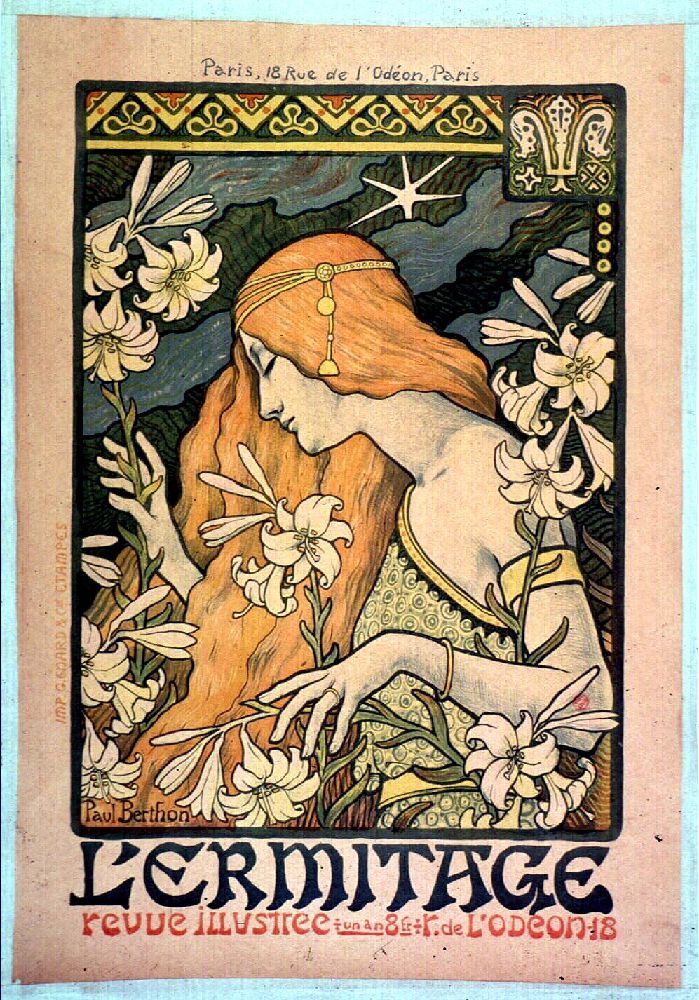
Among the most refined expressions of late nineteenth-century French poster art is Paul Berthon's L'Ermitage (1897), created for the Paris literary review L'Ermitage Revue Illustree. Elegant, lyrical, and unmistakably Art Nouveau in conception, the image occupies an important position in the history of graphic design. Though Berthon is sometimes overshadowed by contemporaries such as Mucha, Grasset, or Cheret, L'Ermitage shows that he was among the more accomplished designers working in the Belle Epoque poster boom.
Today the image is widely reproduced, but the original lithograph and its related states remain objects of real collector interest. To understand why, it helps to place both the artist and the print within the wider development of Art Nouveau graphics, late nineteenth-century literary culture, and the collecting history of the poster itself.
Paul Berthon: biography and formation
Paul Berthon was born in Villefranche-sur-Saone in 1872 and moved into the Parisian art world at a moment when design, print culture, and the decorative arts were converging in new ways. He studied at the Ecole Normale d'Enseignement de Dessin, where the influence of Eugene Grasset proved especially important. Grasset was one of the foundational designers of French Art Nouveau, and Berthon absorbed from him a disciplined approach to line, ornament, and the integration of image with typography and decorative pattern.
Berthon worked as a painter, lithographer, illustrator, and designer, and his surviving oeuvre makes clear that he belonged to the more refined, decorative wing of the poster movement. His art often centers on idealized women framed by flowers, tendrils, and elongated linear rhythms. While some Belle Epoque poster artists leaned toward theatrical publicity or urban immediacy, Berthon frequently pursued mood, grace, and stylization. That difference helps explain why his works often appeal not only to poster collectors but also to collectors of Art Nouveau design more broadly.
Berthon and Art Nouveau graphic art
The 1890s were the great decade of the color lithographic poster in Paris. Technical advances allowed artists to exploit rich color, broad flat passages, and fine linear detail at a scale suited to both public display and later collecting. In this environment artists such as Jules Cheret, Henri de Toulouse-Lautrec, Eugene Grasset, Theophile-Alexandre Steinlen, and Alphonse Mucha transformed the poster from a disposable advertising sheet into an art form in its own right.
Berthon belongs firmly to that history, but his contribution has a distinct tone. His best works combine decorative restraint with a dreamlike sensibility closer to Symbolist illustration than to hard-sell advertising. In that respect he occupies an interesting position between commercial graphics and autonomous decorative printmaking. L'Ermitage is one of the clearest examples of that balance.
The review L'Ermitage and the origins of the poster
L'Ermitage was a Paris literary review associated with the Symbolist milieu. Berthon's design was made for the illustrated review and served both as a cover image and as a poster or poster-like design promoting the periodical. That origin matters, because the print is not merely decorative: it participates in a late nineteenth-century world in which literature, graphic art, and the cult of the magazine were tightly interconnected.
The title itself suggests retreat, contemplation, and cultivated withdrawal. Berthon answered that mood with an image of a red-haired female figure intertwined with stylized lilies and organic Art Nouveau curves. The result is not a loud advertisement but an emblem of poetic and visual refinement. This literary association is part of what gives the poster a collector appeal distinct from more straightforward commercial affiches.
Formal analysis: why the image is so memorable
The composition is dominated by a female bust-length figure whose flowing hair becomes one of the image's principal decorative systems. Her hair descends in rhythmic strands that echo vegetal growth, while the lilies reinforce the Art Nouveau fascination with organic form and symbolic beauty. The typography is integrated into the overall arrangement rather than simply placed on top of it, helping the sheet function as a unified design rather than a mere printed notice.
One of the poster's enduring strengths is its controlled palette. Berthon did not need a riot of color to achieve effect. Instead, the interplay of line, pale grounds, warm hair tones, and floral forms creates a cultivated elegance. In comparison with some more exuberant posters of the period, L'Ermitage can feel quieter, but that restraint is part of its distinction.
Critical opinion and art-historical standing
Modern admiration for L'Ermitage rests on several things at once: its grace of line, its literary associations, and its success as a mature Art Nouveau image. Berthon is often discussed in relation to Mucha because both artists made memorable female-centered decorative compositions. Yet Berthon's handling is typically cooler and more controlled, and his relationship to Grasset gives his design a slightly firmer structural logic than the more luxuriant ornamentalism sometimes associated with Mucha.
Collectors and dealers have long treated L'Ermitage as one of Berthon's signature works, and museums have also validated that standing. The image survives not merely as a famous reproduction but as a catalogued object in institutional collections and as a recognized plate in the history of Art Nouveau poster publishing.
Collecting L'Ermitage: states, formats, and dimensions
Collectors most often encounter L'Ermitage in more than one historical format, and distinguishing them is essential.
1. The 1897 lithograph
A museum-held 1897 lithograph at LACMA is catalogued with a sheet size of 23 1/2 x 17 1/8 inches (59.69 x 43.5 cm) and an image size of 21 1/4 x 13 3/4 inches (53.98 x 34.93 cm). That record gives collectors a dependable benchmark for at least one authentic historical format of the print. Auction examples and trimmed impressions can vary somewhat in visible size, so sheet measurements should always be checked against margins, condition, and possible later mounting.
2. The Les Maitres de l'Affiche version, plate 227
The image also entered the canon of poster collecting through its inclusion as plate 227 in Les Maitres de l'Affiche. This celebrated series, issued for subscribers around the turn of the century, reproduced important posters in a smaller format suitable for portfolios and album storage. For L'Ermitage, the commonly cited plate size is approximately 39 x 30 cm (15.6 x 11.4 inches). Because these sheets were made for collectors from the beginning, they are often encountered in better condition than outdoor display posters and are the format many collectors first meet in the market.
3. Later reproductions
Modern reproductions are widespread. They are useful decoratively and can be perfectly attractive framed, but they do not carry the same historical or collecting weight as early lithographic impressions. For serious buyers, paper quality, printing method, margins, plate marks or blind stamps where applicable, and provenance all matter.
Rarity, condition, and market considerations
As with many Belle Epoque posters, rarity is shaped by original function. Sheets intended for display were vulnerable to paste, tearing, trimming, fading, and disposal. Collector-issued formats such as Les Maitres de l'Affiche naturally had better odds of survival. That does not make the smaller plate common in any trivial sense, but it does mean that the market more often presents that format than a large, pristine original display sheet.
Condition remains critical. Collectors should pay close attention to linen backing, restoration, replaced margins, toning, surface abrasion, and whether the visible dimensions suggest trimming. For Les Maitres de l'Affiche impressions, the presence of expected margins and the general freshness of the sheet can make a meaningful difference in desirability.
Why L'Ermitage still matters
L'Ermitage survives because it captures several important Belle Epoque currents at once: the rise of poster collecting, the union of literature and design, the Symbolist taste for suggestion, and the Art Nouveau transformation of natural form into ornamental rhythm. It is both a beautiful object and a document of a larger cultural moment.
For collectors, that combination is powerful. The print is not merely an attractive image of a red-haired woman with flowers. It is a work tied to a particular review, a particular moment in French graphic art, and a particular collecting tradition that includes museums, poster specialists, and the enduring prestige of Les Maitres de l'Affiche. In that sense, Berthon's L'Ermitage is exactly the sort of object that rewards deeper study: visually seductive at first glance, but richer the more one learns about it.
References
Los Angeles County Museum of Art, L'Ermitage, Paul Berthon, France, 1897.
Wikimedia Commons / Bibliotheque municipale de Lyon, L'Ermitage par Paul Berthon, public-domain image record.
Les Maitres de l'Affiche, plate 227; dimensions commonly cited at approximately 39 x 30 cm (15.6 x 11.4 in.).