
A history longer than its name
There are few American magazines whose histories are so closely entwined with the history of the country as the Saturday Evening Post. Its pages have reflected the ambitions, anxieties, prosperity, prejudices, and changing tastes of American readers for more than two centuries. It helped popularize writers, created enduring images of American life, and became one of the most commercially successful advertising publications in the world.
Yet the story of its origins has long been a source of disagreement. For much of the twentieth century, the Post proudly advertised itself as a publication founded by Benjamin Franklin in 1728. The claim was repeated so frequently that it became part of the magazine's identity, notwithstanding the inconvenient fact that the Saturday Evening Post did not exist under that name until 1821.
The usual explanation is that Cyrus H. K. Curtis, the Philadelphia publishing entrepreneur who acquired the Post in 1897, appropriated the history of Franklin's Pennsylvania Gazette to give his magazine an illustrious pedigree. There is evidence for that interpretation. The magazine itself acknowledges that Curtis introduced the 1728 date into its masthead in 1898, effectively adding 93 years to its published age.
Nevertheless, the suggestion that Curtis invented the connection out of nothing is too dismissive. The printing establishments associated with Franklin, David Hall, and Samuel C. Atkinson can be traced through a succession of proprietors and business partnerships. Their history does not demonstrate continuous publication of the same newspaper, but it provides something more substantial than a coincidental Philadelphia address.
The resulting distinction is important. A newspaper title may disappear while its printing establishment, employees, equipment, and commercial relationships survive. Whether that constitutes continuity depends upon what, precisely, is being claimed.
The Pennsylvania Gazette and Franklin's printing enterprise
The earliest identifiable predecessor in this history was not founded by Franklin at all. On December 24, 1728, Samuel Keimer, a Philadelphia printer and former employer of Franklin, issued the first number of The Universal Instructor in All Arts and Sciences: and Pennsylvania Gazette. Keimer proposed an unusual combination of newspaper and serialized encyclopedia, publishing installments of Ephraim Chambers's Cyclopaedia alongside local and international news.
The undertaking was not particularly successful. In 1729, Franklin and his partner Hugh Meredith acquired the publication, shortened its title to The Pennsylvania Gazette, and transformed its character. Their first issue appeared on October 2 of that year.
Franklin understood that a newspaper could serve several purposes simultaneously. It circulated news and political opinion, attracted advertisements, developed commercial relationships, and promoted the reputation of its proprietor. Shipping notices, advertisements for merchandise and property, public announcements, and reports from abroad shared space with essays and political commentary. Like other colonial newspapers, the Gazette also carried advertisements involving slavery, an integral and troubling part of the commercial world in which it operated.
Franklin gradually became one of the most influential printers in colonial America, and the Gazette was central to his activities. Its pages included the celebrated segmented-snake illustration, Join, or Die, published in May 1754 to promote cooperation among the colonies during the French and Indian War. The illustration later acquired renewed significance during the movement toward independence.
Franklin's growing political responsibilities eventually reduced his direct participation in the printing business. David Hall, a Scottish printer who entered his employment in 1744, assumed increasing responsibility and became his partner in the late 1740s. In 1766, Hall purchased Franklin's remaining interest in the business. Hall subsequently took William Sellers into partnership, and the Gazette continued under their management.
Here the institutional succession is relatively clear. Franklin had not merely permitted someone else to reuse a familiar name. He transferred an existing commercial enterprise with its printing operations and established newspaper. The Gazette survived the transfer, the American Revolution, and Franklin himself.
The newspaper also survived changes in its title and interruptions occasioned by war. During the British occupation of Philadelphia, it was issued temporarily from York, Pennsylvania. After the Revolution it continued under the Hall and Sellers interests, eventually passing through further changes in proprietorship.
The Library of Congress identifies the final issue of the Pennsylvania Gazette as number 4425, dated October 11, 1815. The publication had endured for nearly 87 years.
The missing six years: Hall, Pierie, and Samuel Atkinson
The closure of the Pennsylvania Gazette is the most problematic point in any proposed history extending from Franklin to the Saturday Evening Post.
According to early newspaper historians, the deaths of the Gazette's proprietors precipitated its discontinuance. The final issue repeated an announcement explaining the circumstances and raising the possibility of reviving publication if sufficient subscriptions could be secured. A proposed resumption in May 1816 apparently failed to materialize.
The distinction between the newspaper and the printing establishment is essential. The cessation of the Gazette did not necessarily mean that the business which had printed it disappeared.
The enterprise had operated under the firm Hall & Pierie. Its subsequent history leads to a partnership known as Hall & Atkinson, whose existence is independently documented by contemporary evidence. An 1817 Philadelphia religious publication bears the Hall & Atkinson imprint, as does an 1819 publication associated with the American Convention for Promoting the Abolition of Slavery. A surviving receipt dated June 26, 1819, records Hall & Atkinson printing handbills for John Clement. The 1820 Philadelphia city directory lists Hall & Atkinson as printers at 53 High Street.
These are particularly valuable records because they establish the firm independently of the later historical claims made by Curtis Publishing.
A 1915 publication prepared for the Franklin Printing Company, Benjamin Franklin, Founder: The Remarkable Record of a Philadelphia Institution from 1728 to 1915, describes a succession extending from Franklin through Hall & Pierie, Hall & Atkinson, and subsequent proprietors. Although the account was written long after the events and had a promotional purpose of its own, the contemporary imprints lend credibility to its basic chronology.
There are unresolved questions about which members of the Hall family participated in the various partnerships and precisely how the assets of Hall & Pierie were distributed following the proprietors' deaths. No partnership agreement, estate inventory, or bill of sale has yet established the transfer of the original Gazette's title, subscriber list, or goodwill to Atkinson.
Indeed, the printing establishment appears to have developed its own subsequent history, separate from the newspaper founded in 1821. The business lineage and the magazine's lineage therefore cannot be treated as one uninterrupted chain of corporate ownership.
Still, by 1820 Samuel C. Atkinson was demonstrably associated with a printing firm descended, at least by partnership succession, from the enterprise operated by Franklin's successors. Within a year, he and Charles Alexander launched the Saturday Evening Post.
That sequence gives the Curtis claim a historical foundation. It does not establish that Franklin founded the Post, or that the Post was merely the Gazette under another name. What it suggests is that the new publication emerged from a printing and publishing environment with a genuine connection to Franklin's business.
The six-year interval remains a break in the newspaper's publication history, but it is no longer an unexplained leap between two otherwise unrelated enterprises.
A new newspaper for a growing republic, 1821–1860
 The first issue of the Saturday Evening Post appeared in Philadelphia on August 4, 1821. Its founders, Samuel C. Atkinson and Charles Alexander, created a weekly newspaper intended to entertain and inform a literate public increasingly interested in literature, domestic affairs, science, agriculture, and the rapidly changing American economy.
The early Post was a newspaper in physical appearance, generally consisting of four large pages rather than the illustrated magazine familiar to twentieth-century readers. Its contents, however, anticipated many of the features of the modern general-interest magazine. Fiction, poetry, essays, anecdotes, and practical information accompanied current events and advertisements.
This editorial mixture helped distinguish the Post from newspapers devoted principally to politics and commerce. It also suited the development of a national literary culture at a time when American publishing was still establishing its independence from British models.
The founders' ownership did not remain undisturbed. During the nineteenth century the newspaper passed through a succession of proprietors, editors, and publishing arrangements. Among the more important figures was George Rex Graham, whose publishing activities also encompassed Graham's Magazine. The relationship between these Philadelphia literary enterprises provided opportunities for writers, editors, and illustrators who moved between publications.
The Saturday Evening Post was closely associated with important literary names of the period, including Edgar Allan Poe and James Fenimore Cooper. There is particularly good contemporary evidence of Poe's relationship with the Philadelphia publishing world. On June 6, 1840, the Post printed his prospectus for a proposed literary journal, The Penn Magazine. In February 1841 it announced his editorial appointment at Graham's Magazine.
This was an era in which periodicals played a central role in the development of American literature. Books were relatively expensive, and magazines and literary newspapers offered writers both an audience and a source of income. Their influence extended well beyond the cities in which they were printed, particularly as postal services and transportation improved.
The Post prospered in this environment. Retrospective accounts place its circulation at approximately 90,000 before the Civil War, an impressive figure for a literary weekly operating before the age of inexpensive mass-produced magazines. That number should be regarded as an historical estimate until confirmed by contemporary circulation statements, but there is little doubt that the publication had achieved a substantial national readership.
The nineteenth-century Post was not simply an insignificant precursor awaiting rescue by Curtis. It was a successful newspaper with a distinguished literary record and a readership extending beyond Philadelphia.
From literary prominence to commercial decline
The Post's fortunes declined during the second half of the nineteenth century. The causes were not peculiar to the newspaper. American publishing was changing rapidly as industrial printing, railway distribution, improved illustrations, cheaper paper, and increasingly sophisticated advertising created opportunities for new competitors.
Periodicals became more specialized. Illustrated magazines attracted readers who might formerly have subscribed to literary weeklies. Newspapers expanded their coverage and adopted features previously associated with magazines. Publications whose formulas had proved effective in the 1840s and 1850s faced a substantially different market by the 1880s.
The Post continued to publish, but it no longer occupied the commanding position it had once enjoyed. Its changing proprietorship and increasingly modest commercial circumstances culminated in a remarkable contrast between its earlier success and its condition in the 1890s.
By the time Cyrus H. K. Curtis acquired it in August 1897, circulation had reportedly dwindled to approximately 2,000, although another retrospective account gives 10,473 for a period during Curtis's early ownership. These figures need not be contradictory: they may reflect different reporting dates or different methods of counting circulation. What is indisputable is that the publication had become a marginal enterprise.
Curtis paid approximately $1,000 for the newspaper. He was not acquiring an established commercial powerhouse. He was purchasing an old name, a history, and the possibility of building something new.
Cyrus Curtis and the invention of the modern Post
Cyrus Hermann Kotzschmar Curtis was already a successful publisher when he acquired the Saturday Evening Post. His greatest achievement to that point had been the Ladies' Home Journal, which evolved from a women's supplement developed by his wife, Louisa Knapp Curtis, into one of the most influential magazines in America.
Curtis understood the economics of mass circulation better than many of his contemporaries. He recognized that a magazine's profitability need not depend principally upon the price paid by its readers. A large and commercially attractive audience could itself be sold to advertisers. Subscription and newsstand revenues might cover only a fraction of the actual cost of production, with advertising providing the greater part of the income.
The Saturday Evening Post became the most spectacular demonstration of that principle.
Curtis recruited George Horace Lorimer, a young journalist whose editorial judgment would prove exceptionally important. Lorimer became editor in 1899 and remained in that position until 1936. Under their direction, the Post abandoned much of its provincial character and adopted an increasingly national perspective.
Business, industry, public affairs, adventure, fiction, and human-interest stories became prominent. Curtis initially imagined a magazine appealing especially to ambitious men, but its audience eventually extended well beyond that narrow conception. The Post increasingly addressed the aspirations and habits of middle-class America.
Curtis also committed extraordinary resources to promotion. His magazine's own history estimates that he invested approximately $1.25 million in the undertaking during its early development, an immense amount for the period.
The results were dramatic. Circulation reached approximately 250,000 by 1900 and exceeded one million weekly copies by the end of 1908. By 1913 it had reached approximately two million. The circulation achievements made the magazine attractive to national advertisers, whose spending financed further editorial expansion, improved illustrations, and additional circulation growth.
The Post became an important commercial link between American manufacturers and consumers. Its advertisements introduced readers to nationally distributed foods, household goods, automobiles, clothing, medicines, and countless other products. They also helped create and reinforce expectations about domestic comfort, personal advancement, and consumer prosperity.
For historians and collectors, these advertisements now provide an unusually rich record of American commercial life. They document not merely the products offered for sale, but the language, imagery, and aspirations through which advertisers attempted to reach their customers.
The old newspaper had become a mass-market institution.
An illustrated portrait of America
The magazine's influence was not limited to what readers found inside its pages. Its illustrated covers became some of the most recognizable images in American publishing.
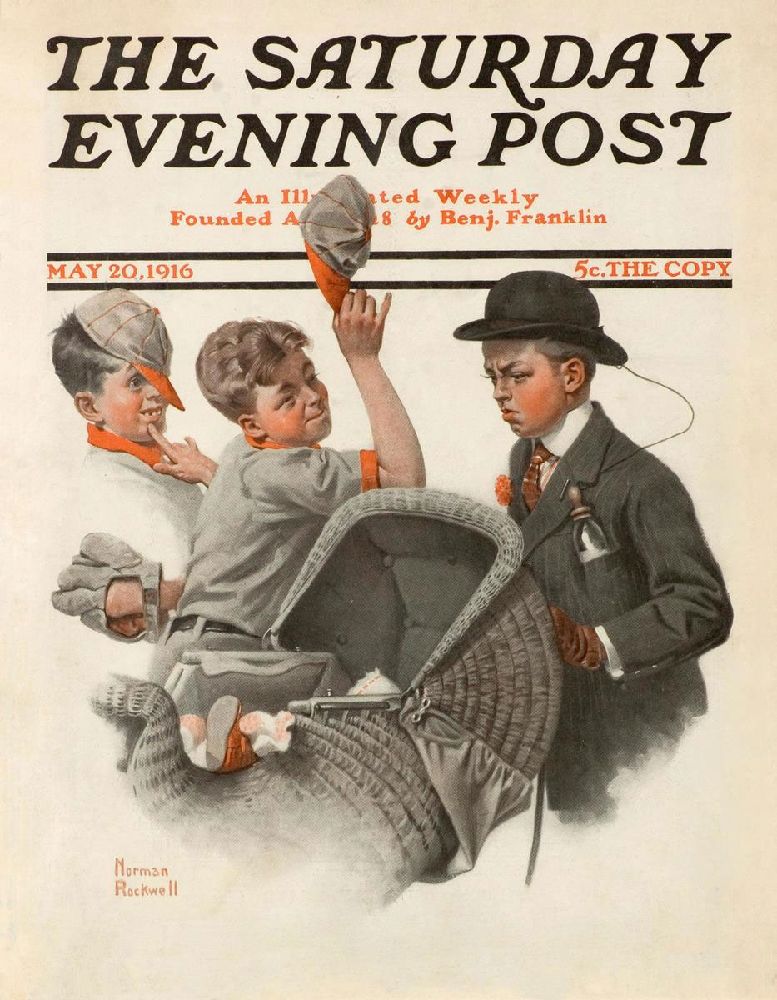
Norman Rockwell contributed his first Post cover in 1916, beginning a relationship that would last 47 years and produce 322 original cover illustrations. Other prominent illustrators included J. C. Leyendecker, N. C. Wyeth, and George Hughes.
Rockwell's paintings are now so closely identified with the Saturday Evening Post that the two are frequently treated as inseparable. Yet Rockwell belonged to a broader tradition of American commercial illustration, and the magazine's success provided a market in which that tradition could flourish.
The Post commissioned illustrations on a scale made possible by its vast advertising revenue. It could afford artists whose work attracted readers in its own right, establishing a commercial relationship between illustration, editorial content, and circulation.
The covers frequently portrayed an idealized America of families, children, small towns, professionals, tradespeople, and everyday social encounters. Humor was common, as were nostalgia and sentiment. The paintings could be affectionate, gently satirical, or patriotic, and they became visual shorthand for a particular understanding of American life.
The magazine's influence was also political and cultural. Under Lorimer it frequently expressed confidence in enterprise, individual advancement, and the virtues of business. Its editorial positions were not neutral reflections of public opinion. They helped shape opinion, sometimes forcefully.
Lorimer's resistance to Franklin D. Roosevelt's New Deal, for example, reflected a broader ideological commitment to limited government and established business interests. His positions became increasingly difficult to reconcile with the country's changing political environment during the Depression. Historical scholarship has also examined the magazine's nativist tendencies during and after the First World War.
The Post could promote an ideal of national unity while failing to represent many Americans in its pages. Its images and editorial choices often reflected the racial, social, and economic assumptions of its predominantly white, middle-class audience. That history, too, is part of its significance.
At its best, however, the magazine was capable of addressing larger questions of American identity. Rockwell's 1961 Golden Rule cover, representing people of different backgrounds beneath an appeal to mutual respect, illustrated how its familiar visual language could be employed to suggest a broader national community.
The Post was therefore more than a collection of attractive illustrations and popular stories. It was an influential participant in the construction of twentieth-century American culture.
Circulation and commercial influence
The extraordinary scale of the Post's twentieth-century success can be appreciated through its circulation history.
Year | Approximate circulation per issue | Historical significance |
|---|---|---|
Before 1861 | 90,000 | Reported nineteenth-century high |
1897 | 2,000 | Estimated circulation at Curtis acquisition |
1900 | 250,000 | Early Curtis expansion |
1908 | 1,000,000 | National mass-market breakthrough |
1913 | 2,000,000 | Expansion of advertising-based publishing |
1937 | 3,000,000 | Continued growth despite Depression-era difficulties |
1949 | 4,000,000 | Postwar prosperity |
1954 | Nearly 5,000,000 | Expanding consumer economy |
1960 | Approximately 6.9 million | Peak-era circulation |
1971 | 630,000 initial print run | Relaunch after suspension |
1972 | Approximately 800,000 print run | Early revival |
Early 1990s | Approximately 555,000 | Established bimonthly publication |
2013 | Approximately 360,000 | Reported circulation during another editorial transition |
Figures are rounded and drawn from historical accounts, the magazine's retrospective histories, and contemporary reporting. The 1971–1972 figures are print runs rather than necessarily paid circulation, and are not strictly comparable with subscriber counts.
Approximate copies per issue, millions. Selected historical circulation estimates, 1897–1960.
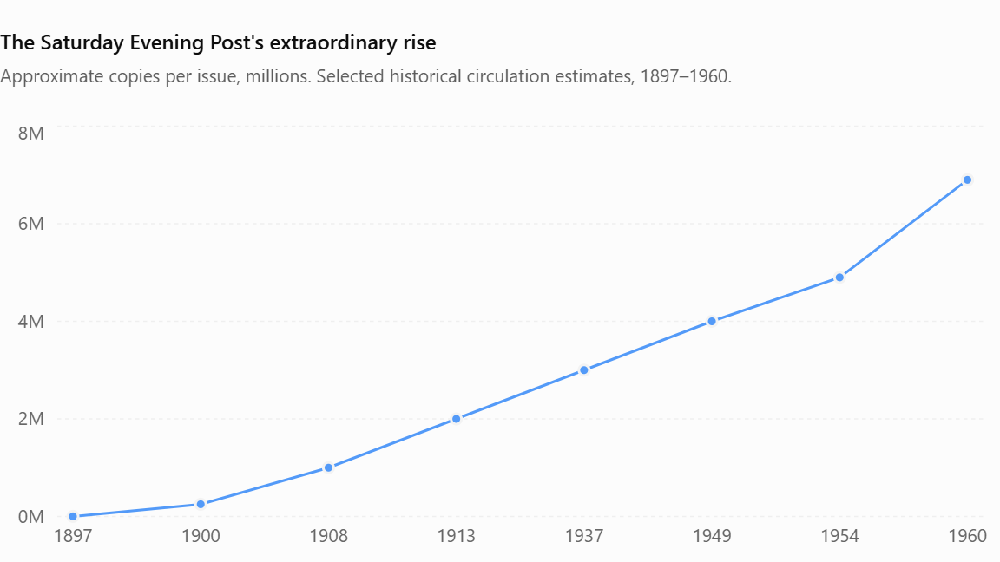
By the middle of the twentieth century, the Saturday Evening Post was among the largest general-interest magazines in the United States. Its reach was sufficient to make a national advertising campaign in its pages a major commercial undertaking.
This influence, however, created vulnerabilities. Producing and distributing millions of copies required expensive printing plants, paper supplies, postal arrangements, editorial staffs, and administrative systems. The economics worked extraordinarily well while advertisers were willing to support the operation. They became considerably less forgiving when advertising revenues weakened.
The circulation figures also conceal an important distinction between popularity and profitability. A magazine might retain millions of readers while losing money on every additional copy if subscription prices were too low and advertising no longer covered the shortfall.
The system Curtis had pioneered ultimately became one of the liabilities of his successors.
The long decline of Curtis Publishing
Cyrus Curtis died in 1933, leaving an enormous publishing enterprise whose principal properties included the Saturday Evening Post and the Ladies' Home Journal. Family interests continued to exercise influence, although the business was not simply a private family partnership. Curtis Publishing had outside shareholders, directors, and increasingly complex financial commitments.
George Horace Lorimer retired in 1936. His successors inherited a magazine whose editorial formula had been extraordinarily successful but whose audience was changing.
The Post continued to prosper commercially for many years. Its circulation expanded during and after the Second World War, helped by the growth of middle-class household purchasing power and the national consumer economy. Yet the rise of radio, and more decisively television, challenged the assumptions upon which its advertising business had been built.
Television offered advertisers access to large audiences with moving images, sound, and immediate emotional appeal. Magazines retained advantages, particularly in reaching specialized or affluent readers, but the era in which a handful of general-interest publications dominated national advertising was drawing to a close.
Curtis Publishing faced additional difficulties arising from its investments and management decisions. The company had committed resources to paper production and other operations that exposed it to costs and risks beyond ordinary magazine publishing. Changes in leadership produced conflicting strategies, while the expense of maintaining the Post's enormous circulation became increasingly difficult to justify.
The magazine's editorial identity was also unsettled. A newer generation of readers encountered more contemporary approaches to journalism in competing publications. The Post's familiar blend of fiction, wholesome illustration, and middle-class aspiration increasingly competed with more immediate reporting, changing social attitudes, and television entertainment.
There were expensive legal problems as well. In Curtis Publishing Co. v. Butts, decided by the Supreme Court in 1967, the magazine became involved in a landmark libel case arising from an article accusing a college football official of participating in a game-fixing conspiracy. The litigation imposed financial costs and established important principles concerning defamation law and public figures.
By the late 1960s, Curtis Publishing was in severe financial difficulty. Martin S. Ackerman, associated with Perfect Film and Chemical Corporation, became a central figure in attempts to reorganize the company. Transactions involving ownership of the magazine and other Curtis assets later produced litigation and regulatory scrutiny.
The Post itself reported that the company had accumulated approximately $67 million in debt and had experienced repeated changes of presidents and editors during its final years under the old management.
The difficulties were not attributable to television alone. They reflected a combination of changing markets, financial commitments, management instability, and a publishing model whose enormous scale had become increasingly expensive to sustain.
On February 8, 1969, the Saturday Evening Post ceased publication.
The event was widely treated as the end of an American institution. TIME observed at the time that the company had lost approximately $62 million since 1961, while advertising revenue was insufficient to support the magazine's costs.
Yet the Post was not dead.
The SerVaas revival: 1969–1982
Indianapolis businessman Beurt SerVaas recognized that the failed publishing company still possessed assets of value, particularly its established magazine titles and their reputations.
He acquired control of the troubled Curtis enterprise during the 1969–1970 reorganization. The publishing operation moved to Indianapolis, where he and his wife, Corena “Cory” SerVaas, set about reviving the Post.
The new owners did not attempt to recreate the old magazine in its entirety. The Post returned in 1971 as a quarterly publication, initially priced at one dollar. Its familiar large format and historic visual identity were retained, but its production schedule and business organization were substantially reduced.
The first revived issue reportedly sold its entire printing of 630,000 copies. Print runs reached approximately 800,000 by the following year. Those figures demonstrated that the magazine still enjoyed substantial goodwill among readers, even though its previous business model had collapsed.
The SerVaases emphasized nostalgia, traditional illustration, historical reminiscence, and subjects appealing to the magazine's established audience. Their approach recognized something the financially troubled Curtis management had struggled to exploit: the Post's history and accumulated cultural associations had become valuable properties in themselves.
Cory SerVaas increasingly directed the magazine's editorial development, with greater emphasis on medicine, personal health, and public service. During the 1970s, its contents reflected both the nostalgic appeal of its earlier reputation and a developing educational mission.
In 1982, ownership passed to the Benjamin Franklin Literary and Medical Society, a nonprofit organization established under Cory SerVaas's leadership. The transaction changed the legal and institutional nature of the publication. It was no longer owned in the ordinary sense by a commercial publishing entrepreneur seeking returns for shareholders.
The choice of Benjamin Franklin's name was an interesting echo of the promotional ancestry Curtis had adopted more than eighty years earlier. The Franklin connection had become an enduring part of the institution's identity, regardless of the unresolved question of direct newspaper succession.
The Post in the twenty-first century
The nonprofit organization subsequently became known as the Saturday Evening Post Society, which remains the magazine's publisher.
The SerVaas family's involvement continued through another generation, with Joan SerVaas assuming leadership. The publication also retained the children's magazines Jack and Jill and Humpty Dumpty, extending the organization's activities beyond the historic Post.
By the early 1990s, the revived magazine had a circulation of approximately 555,000. A report from 2013 put circulation at approximately 360,000, far below its mid-century peak but still significant for a general-interest print publication operating in a substantially changed media environment. Neither figure should be assumed to represent circulation today.
The magazine underwent another editorial overhaul in 2013, renewing its attention to American history, literature, art, and cultural subjects. Its website and digital archives have since become important means of presenting the publication's historical material to contemporary readers.
The present magazine bears relatively little operational resemblance to Curtis's enormous weekly enterprise, let alone Franklin's colonial newspaper. It is a nonprofit publication, with a smaller circulation, a different audience, and substantial digital activity.
Nevertheless, it continues to use the Saturday Evening Post name, possesses an extraordinary historical archive, and remains connected to the publishing traditions established in Philadelphia more than two centuries ago. Its official website identifies the Saturday Evening Post Society, headquartered in Indianapolis, as its publisher.
In some respects, the magazine's modern status is consistent with a pattern visible throughout its history. It has repeatedly changed proprietors, editorial formulas, publishing schedules, and commercial models while preserving enough of its identity to claim continuity with its predecessors.
Franklin's legacy: an inheritance or an invention?
The claim that the Saturday Evening Post began in 1728 is, in the strict bibliographical sense, incorrect. The Post began publication on August 4, 1821, nearly a century after Samuel Keimer established the Pennsylvania Gazette. Franklin himself was not its founder, having acquired the earlier newspaper in 1729.
The evidence does not support treating the two publications as a single newspaper issued continuously under successive titles. The Pennsylvania Gazette ceased in October 1815, and the intervening six years cannot simply be erased.
Yet this does not dispose of the Curtis claim.
The succession of Franklin's printing enterprise through David Hall and later Hall partnerships is documented. The existence of Hall & Atkinson is supported by contemporary printed works, a commercial receipt, and an 1820 Philadelphia directory. Samuel C. Atkinson's role in founding the Saturday Evening Post the following year provides a tangible connection between the enterprises.
The missing evidence concerns the precise character of that connection. A printing partnership may have carried forward presses, type, personnel, accounts, and professional relationships without inheriting the title or circulation of an earlier newspaper. Indeed, the Franklin Printing Company's independent history suggests that continuity of the printing establishment and continuity of the newspaper must be considered separately.
Curtis's adoption of the 1728 date in 1898 therefore represented an enlargement of a plausible historical association into a more sweeping claim of institutional antiquity. It was commercially advantageous, certainly, but not necessarily a fabrication without foundation.
Whether the Post should be described as a descendant of the Pennsylvania Gazette depends upon the definition of descent. As a continuously published newspaper, the connection remains unsubstantiated. As an enterprise emerging from a recognizable lineage of Philadelphia printers, it has considerable historical substance.
An original partnership agreement, probate inventory, or notice concerning the distribution of Hall & Pierie's assets could establish much more. Until such evidence appears, the distinction deserves to remain open rather than be resolved by either promotional tradition or categorical dismissal.
An institution repeatedly reinvented
The history of the Saturday Evening Post is ultimately a history of reinvention.
The earliest enterprise began as an ambitious but unsuccessful newspaper founded by Samuel Keimer. Franklin transformed it into a commercially successful and politically influential publication. His successors maintained the printing business and the Gazette through the Revolution and into the early republic, until the newspaper finally ceased.
A succeeding generation of Philadelphia printers created the Saturday Evening Post in 1821. It developed into an important literary weekly, attracted nationally recognized writers, and achieved a readership extending well beyond its home city. Then it declined as publishing technology and public tastes changed.
Curtis's achievement was not merely rescuing the old newspaper. He recognized the potential to transform it into something substantially different. With George Horace Lorimer, he created a national mass-market magazine supported by advertising, reaching millions of American households and influencing the country's commercial and cultural life.
That empire eventually collapsed under pressures which its founders had not anticipated. Yet the name and its accumulated cultural associations survived, allowing another generation of publishers to build a viable, smaller institution around them.
The modern nonprofit magazine is different again, preserving and interpreting a historical inheritance rather than attempting to recreate the commercial enterprise that dominated American publishing in the middle of the twentieth century.
Few American periodicals have undergone so many transformations while retaining such a recognizable identity.
The most defensible historical conclusion is neither that the Saturday Evening Post has published without interruption since 1728 nor that its Franklin ancestry was wholly invented by Cyrus Curtis. Its real history is more complicated, and considerably more interesting: a succession of printing businesses, newspaper ventures, publishing entrepreneurs, and institutional reinventions, connected by a mixture of documented inheritance, commercial opportunity, and carefully cultivated tradition.
That is a substantial history without the need to manufacture a continuous one.
References and sources for further research
Early printing and newspaper history
1. Library of Congress. The Pennsylvania Gazette (Philadelphia, Pa.), 1782–1815. Bibliographic record identifying the final publication period and surviving newspaper holdings.
2. Clarence S. Brigham. Historical bibliography of early American newspapers, in Proceedings of the American Antiquarian Society (1922). Includes details of the final issues of the Pennsylvania Gazette, the proprietors, and the proposed resumption in 1816.
Read the historical bibliography
3. J. Linton Engle, compiler. Benjamin Franklin, Founder: The Remarkable Record of a Philadelphia Institution from 1728 to 1915. Philadelphia: Franklin Printing Company, 1915. Important retrospective account of the succession of printing establishments, particularly Hall & Pierie and Hall & Atkinson. The work should be read with awareness of its promotional purpose.
4. American Antiquarian Society. Book Trades Collection, Series I inventory. Contains a June 26, 1819, receipted bill from Hall & Atkinson to John Clement for the printing of handbills.
5. James Melvin Lee. History of American Journalism. Boston: Houghton Mifflin, 1917. Provides a retrospective discussion of the end of the Pennsylvania Gazette and the disposal of its printing equipment.
Nineteenth-century Saturday Evening Post
6. The Saturday Evening Post. “Celebrating 200 Years: The Saturday Evening Post Is Born” (2021). Retrospective history of the 1821 founding, nineteenth-century literary contributors, and reported circulation.
7. Edgar Allan Poe Society of Baltimore. Chronology of the Life of Edgar Allan Poe. Documents the publication of Poe's proposed Penn Magazine prospectus in the Saturday Evening Post on June 6, 1840, and other connections with Philadelphia literary publishing.
8. University of Pennsylvania. Saturday Evening Post digital archive index. A route to surviving nineteenth-century issues useful for examining mastheads, advertisements, publishing arrangements, and editorial changes directly.
Curtis publishing and twentieth-century history
9. Jan Cohn. Creating America: George Horace Lorimer and The Saturday Evening Post. University of Pittsburgh Press, 1989. Scholarly study of Lorimer's editorial influence and the magazine's development as a national institution.
10. The Saturday Evening Post. “A Saturday Evening Post History in Logos” (2018). Particularly important because it acknowledges Curtis's adoption of the 1728 founding date in the 1898 masthead.
11. The Saturday Evening Post. “History of The Saturday Evening Post.” Institutional history covering Curtis's acquisition, circulation growth, editorial leadership, financial collapse, and revival. Useful for broad chronology, although its interpretations naturally reflect the publication's perspective.
12. TIME. “The Press: The Saturday Evening Post” (1969). Contemporary reporting on the decision to cease publication and the Curtis company's financial difficulties.
13. Columbia Journalism Review. “The Persistence of The Saturday Evening Post” (2021). Examination of the magazine's cultural influence, editorial history, collapse, and modern survival.
Modern ownership and revival
14. Encyclopedia of Indianapolis. “Saturday Evening Post,” revised February 2021. Details the SerVaas acquisition, relaunch circulation, 1982 nonprofit transfer, and later editorial changes.
15. The Saturday Evening Post Society. Official organizational information, including nonprofit status and current publishing activities.
Official publisher information
Unresolved questions and avenues for further investigation
The available research supports several specific opportunities for original historical work.
The most important is the precise disposition of the Hall–Pierie enterprise following the proprietors' deaths. The October 11, 1815, final issue, contemporary advertisements, probate files, and partnership records may establish whether Samuel C. Atkinson acquired an interest in the existing printing business or merely entered a successor arrangement. The known 1819 Hall & Atkinson receipt establishes commercial activity but does not disclose the firm's underlying ownership.
A second question concerns the first years of the Saturday Evening Post. Its 1821 prospectus and early issues may disclose whether Atkinson and Alexander explicitly represented the newspaper as a continuation of an earlier publication. A statement of succession issued by the founders themselves would carry far greater evidentiary weight than anything published under Curtis decades later.
The third concerns nineteenth-century circulation. The frequently quoted pre-Civil War figure of 90,000 is plausible but needs independent corroboration through advertising prospectuses, publisher statements, or contemporary industry reports.
Finally, the decline of Curtis Publishing deserves separate treatment as a business history. Otto Friedrich's Decline and Fall (1970), the company's financial statements, shareholder litigation, and Federal Trade Commission proceedings provide material for investigating whether the magazine was ultimately destroyed by changing commercial circumstances, managerial failures, or some combination of both.
These questions need not prevent publication of the present article. They establish the boundary between what the surviving evidence supports and what remains an attractive, but unproved, historical interpretation.