
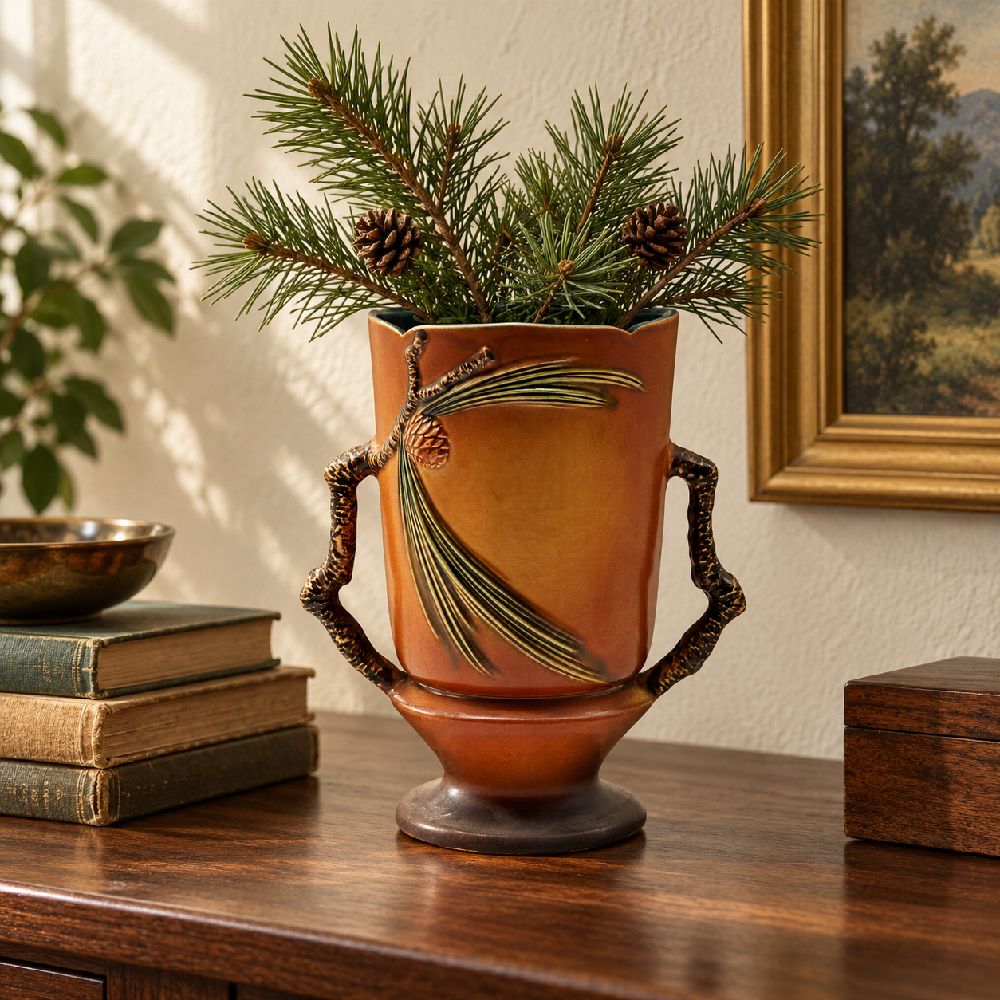
 A Roseville vase priced at $5.95 in 1948 sounds almost absurdly inexpensive today. Seventy-eight years later, even a modest lunch can cost more. It is tempting to put an old Roseville advertisement beside a modern dealer listing and marvel that a vase once priced at five or six dollars may now be offered for $150 or $200.
That comparison, however, tells only part of the story.
The more interesting question is not how many dollars the vase cost. It is how much work was required to buy it.
Once Roseville prices are measured in hours of contemporary wages, rather than simply compared as nominal dollar amounts, the history looks quite different. A good Roseville vase was not a five-dollar trifle. For many of the consumers likely to encounter it in a department-store gift department, it represented several hours of earnings and, at the upper end, most of a working day.
Measured the same way today, a surprising amount of ordinary Roseville occupies approximately the same economic territory.
That may be one of the secrets of Roseville's enduring popularity. The pottery has become collectible without, in most cases, becoming inaccessible.
Roseville Was Made in Serious Quantities
It is useful to begin with the scale of the enterprise, because Roseville was not a studio pottery producing a few hundred individually conceived objects a year.
The Roseville Pottery Company was incorporated in 1892 and grew rapidly around the Zanesville, Ohio, pottery industry. The Smithsonian's National Museum of American History reports that by 1905 Roseville employed more than 300 people and was producing more than 1,000 finished pieces per day. By 1915 its production had been standardized around molds, assembly-line decoration and firing methods suitable for large-scale manufacture.
Even without surviving annual production ledgers, the implication is unmistakable. Roseville was capable of producing hundreds of thousands of finished objects in a year. Its later floral patterns were commercial products intended for national distribution, not limited-edition art objects.
That distinction matters when discussing present value. Most surviving Roseville was never intrinsically rare. It became collectible because it was attractive, identifiable and well made—not because only fifty examples existed.
The breadth of individual lines reinforces the point. Bleeding Heart, introduced in 1940, encompassed 48 shapes. Freesia, introduced in 1945, was advertised with 48 shapes, with 47 represented on surviving factory stock pages. Snowberry, introduced in 1947, included 52 different shapes.
Roseville therefore supplied collectors with something particularly durable as a collecting field: tremendous variety, recognizable patterns and mold numbers, but enough production that many desirable examples remain obtainable.
What Roseville Actually Cost in the Store
Contemporary advertisements provide a clearer picture of Roseville's original retail position than modern memories of “cheap pottery.”
A 1940 Texas department-store advertisement offered Roseville Bleeding Heart vases, bowls and related pieces regularly priced up to $1.50 for $1 during a Dollar Day sale. The advertisement specifically names the Bleeding Heart pattern, which had been introduced that year.
Eight years later, a particularly useful advertisement appeared in the Big Spring Daily Herald on April 22, 1948. The department store advertised five individual Roseville forms “as sketched.” A glazed flower vase was $5.95; another glazed flower vase was $3.95; a glazed bud vase was $3.95; an ivy planter or flower vase was $2.50; and a dull-finish flower vase was $2.50. The advertisement described Roseville as American-made pottery available in green, blue and rose finishes.
By 1952, a Washington department store was clearing six Roseville pottery vases that had carried a regular retail price of $7.50 each, reducing them to $3.49. The important number for our purpose is the stated regular price, not the markdown.
These advertisements establish a broad trajectory. Better Roseville giftware was moving through department stores at prices of several dollars per piece, with $5 to $7.50 entirely plausible for a vase during the company's later years.
Those numbers become meaningful only when we ask what consumers earned.
The $5.95 Vase Was Not Cheap
The Bureau of Labor Statistics conducted detailed surveys of office-worker salaries in American cities during 1947 and 1948. These are particularly useful for thinking about Roseville because office and clerical workers provide a plausible middle-income consumer benchmark for department-store giftware.
They should not be treated as a demographic study of Roseville purchasers; we do not have evidence telling us precisely who bought a particular vase. They do, however, tell us what the discretionary purchase represented to an ordinary salaried consumer.
In Atlanta in December 1947, women clerk-typists earned an average of $33.14 per week and worked an average scheduled week of 39.8 hours. Their average straight-time wage was therefore about 83 cents an hour. Women general stenographers averaged $39.42 per week, while hand bookkeepers averaged $44.41. Across the cities surveyed, clerk-typist weekly wages included $33.91 in Dallas and $39.37 in Seattle.
Now return to the Roseville counter in 1948.
For the Atlanta clerk-typist earning about 83 cents an hour, the $2.50 Roseville vase represented approximately three hours of work. The $3.95 vase represented about 4¾ hours. The $5.95 vase required a little over seven hours of gross earnings.
That is almost a full working day.
The Census Bureau offers another perspective. Median American family income in 1948 was approximately $3,200 a year. Twenty-one million of the nation's roughly 35½ million families had incomes between $2,000 and $5,000.
A $5.95 decorative vase was therefore not equivalent to picking up an inexpensive accessory in a modern discount store. It was an attainable purchase, but one with enough economic weight to be considered.
Roseville was affordable quality. It was not disposable décor.
Hours of Work Give Us a Better Measure of Value
That distinction becomes particularly interesting when the old prices are compared with today's specialist market.
The Bureau of Labor Statistics reported that in May 2025 the median wage for American office and administrative support occupations was $22.81 per hour. General office clerks had a median wage of $21.64.
Consider several ordinary, identifiable Roseville pieces currently or recently offered by Just Art Pottery, a specialist dealer whose inventory provides a useful view of the established collector retail market.
A Roseville Snowberry blue bud vase, shape 1BV-7, was offered at $112.50. At $22.81 per hour, that represents approximately 4.9 hours of work.
A Bleeding Heart blue cornucopia, shape 141-6, was offered at $130.50, representing roughly 5.7 hours at the same wage.
A Wincraft orange vase, shape 283-8, introduced in 1948, was offered at $157, or about 6.9 hours of contemporary office-support wages.
A Freesia blue vase, shape 126-10, was offered at $195, equivalent to about 8.5 hours.
A Bleeding Heart blue vase, shape 139-8, was offered at $198, or about 8.7 hours, while the more sculptural Bleeding Heart 970-9 was priced at $247, about 10.8 hours of work.
These are not exact matches to the unidentified shapes illustrated in the 1948 advertisement, and they should not be represented as such. The surviving advertisement provides prices but not readable Roseville mold numbers; the modern listings provide mold numbers but are not necessarily those exact advertised forms.
For an examination of broad economic value, however, the comparison is illuminating.
Illustration | Period or current price | Approximate hours of clerical/office work |
1948 Roseville flower/planter vase | $2.50 | 3.0 hours |
1948 Roseville vase | $3.95 | 4.7 hours |
1948 Roseville better vase | $5.95 | 7.1 hours |
Current Snowberry 1BV-7 | $112.50 | 4.9 hours |
Current Bleeding Heart 141-6 | $130.50 | 5.7 hours |
Current Wincraft 283-8 | $157 | 6.9 hours |
Current Freesia 126-10 | $195 | 8.5 hours |
Current Bleeding Heart 139-8 | $198 | 8.7 hours |
Current Bleeding Heart 970-9 | $247 | 10.8 hours |
The striking number in that table is not $247.
It is 6.9 hours versus 7.1 hours.
A good $5.95 Roseville vase in 1948 consumed approximately seven hours of an Atlanta clerk-typist's pay. A $157 specialist-priced Wincraft vase today consumes approximately seven hours at the current median wage for American office and administrative support work.
Different pieces, different workers and different economies make this an illustration rather than a mathematical index. Nevertheless, the scale is remarkably similar.
Has Ordinary Roseville Held Its Value?
Measured this way, the answer appears to be: quite often, yes.
That does not mean Roseville has been a spectacular financial investment. In fact, the evidence suggests almost the opposite.
A large part of Roseville's ordinary collector market appears to have preserved approximately the economic weight it possessed when new. A vase that once represented several hours of wages may still represent several hours of wages. Some pieces have done better; others have done worse.
That is a very different proposition from looking at $5.95 in 1948 and $157 today and announcing a twenty-six-fold increase.
The worker buying the vase in 1948 did not experience it as a six-dollar object. She experienced it as perhaps seven hours of earnings. The modern collector buying the Wincraft example does not experience it as 157 abstract dollars. At a representative office wage, it also represents approximately seven hours.
The nominal number has changed dramatically. The economic burden has not.
That is a reasonable definition of holding value.
The Collector Market Has Not Moved in a Straight Line
Roseville's modern history also warns against treating antiques as a continuously appreciating asset.
Just Art Pottery has published actual sales histories for identical or closely comparable Roseville shapes sold through its business over periods of many years. The results are revealing.
A Sunflower vase, shape 487-7, sold for $1,050 in 2004, declined through subsequent years and sold for $550 in 2022. A Baneda vase, shape 603-4, brought $495 in 2004 and $445 in 2021 after moving considerably lower during the intervening period. A Wisteria 629-4 brought $495 in 2007, fell as low as $225 in 2011–12, and was back to $365 in 2023. A Bushberry 34-8 moved from $265 in 2006 to $225 in 2020.
That is not the behavior of a uniformly appreciating investment class.
It is the behavior of a mature collecting market.
Fashion changes. Generations of collectors enter and leave. Large collections return to the market. Some patterns become fashionable while others soften. Condition, glaze, color and mold quality matter. A piece may command less today than it did during a particularly enthusiastic collecting period twenty years ago.
Yet Roseville has not disappeared from the market. It continues to sell, continues to be catalogued by pattern and shape, and continues to support specialist dealers.
That stability may matter more than spectacular appreciation.
Then There Is the Other Roseville
None of this means that all Roseville is inexpensive.
Ordinary production is only one side of the collecting field.
Roseville produced unusual designs, scarce forms, experimental glazes and patterns whose present demand bears little resemblance to that for an ordinary floral vase. Futura, introduced around 1928, is perhaps the clearest example. Its aggressively Art Deco forms include approximately 78 designs shown in factory stock pages, and collectors have given many forms nicknames such as “Michelin Man,” “Elephant Leg” and “Tank.”
A current Just Art Pottery offering for a Futura Chinese footed vase, shape 430-9, is priced at $1,615.50. A Futura Weeping Tulip vase, shape 437-12, has been offered at more than $900.
Baneda occupies another higher tier. Current specialist offerings include a Baneda green 597-10 at $1,129, while more modest Baneda forms are offered in the several-hundred-dollar range.
These pieces are the counterpoint, not the baseline.
They demonstrate that rarity, form, color and collector preference can push particular Roseville objects far above the labor-value relationship seen in ordinary production. They are also part of what keeps the field interesting for advanced collectors. A person can begin with an attractive $100 vase and spend years learning enough to appreciate why another Roseville vase costs $1,000.
But the existence of those pieces should not distort our understanding of Roseville as a whole.
Perhaps Roseville's Lack of Runaway Appreciation Is an Advantage
There is a tendency in collecting to regard rising prices as proof of importance.
That is not necessarily so.
Roseville occupies an unusually attractive middle ground. It is historically significant American pottery. Its best designers produced distinctive work. Its patterns and mold numbers invite study. Its huge range of forms makes specialization possible. Its survival rate is sufficient that collectors can still find examples without waiting years for one to appear.
And, crucially, much of it remains affordable.
A collector does not generally need Lalique money to buy good Roseville.
That may sound like a weakness if antiques are viewed primarily as investments. It looks more like a strength if collecting is understood as the acquisition of interesting, attractive historical objects.
The Smithsonian's production figure helps explain why. Roseville was already making more than 1,000 finished pieces a day in 1905, decades before many of the floral lines most familiar to collectors appeared. The company later adopted standardized mass-production techniques and offered dozens of forms within individual patterns. Roseville made a great deal of pottery.
Enough survived to keep supply alive.
At the same time, the pottery was sufficiently expensive when new to embody real craftsmanship and discretionary spending. A $5.95 vase could absorb nearly a day's wages for a clerical worker. It was not made to be thrown away.
Those two circumstances—large production and meaningful original cost—may have created Roseville's modern sweet spot.
There are enough pieces that ordinary Roseville has not become prohibitively scarce, but the pottery was good enough to remain worth preserving.
Roseville May Have Done Exactly What a Collectible Should Do
There are collectibles whose price histories make spectacular investment stories. Roseville, considered broadly rather than through its exceptional rarities, may tell a quieter and ultimately more useful story.
A substantial Roseville vase cost several hours of work when Franklin Roosevelt or Harry Truman was president. A substantial Roseville vase can still cost several hours of work today.
The purchaser receives something the original buyer would recognize immediately: a carefully designed American ceramic object with a distinctive glaze, recognizable pattern and considerable decorative presence.
That is not explosive appreciation.
It is continuity.
And perhaps that helps explain why Roseville continues to have a steady following long after so many once-fashionable collectibles have faded. The market has generally allowed the pottery to remain what it originally was: well-made decorative art within reach of ordinary people who care enough about it to spend part of a day's wages.
For the collector, that may be better than a price chart that only goes up.